Anthropic’s 17% IPO Gain Couldn’t Halt a Broad Market Sell-Off
Anthropic surged on its debut, yet major indexes fell as investors weighed AI valuations, volatile trading and company-specific risks.
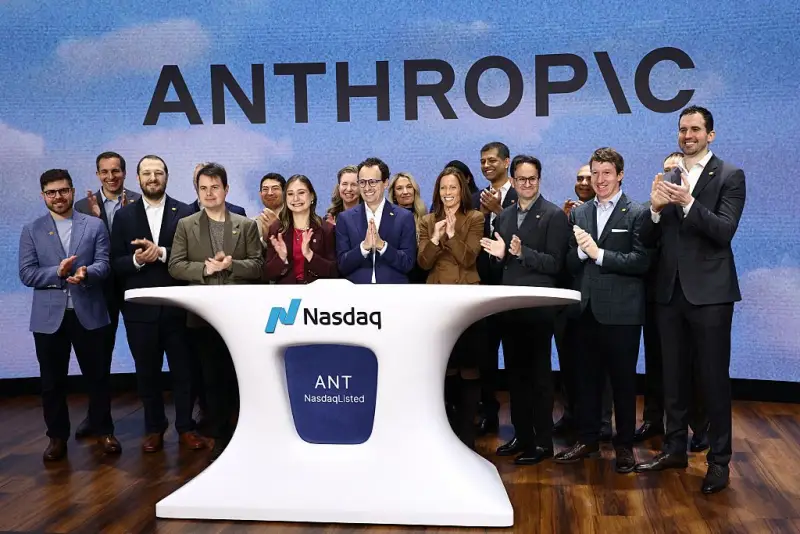
Anthropic’s record-setting stock debut drew attention, but it didn’t steady the broader market. Shares opened well above their initial public offering price and finished sharply higher, while major U.S. indexes dropped on Thursday amid renewed doubts about AI valuations and the spending needed to support the sector’s growth.
Anthropic’s debut sets a demanding benchmark
Anthropic priced its shares at $83, above the expected range of $70 to $78. The company raised $81.3 billion by selling about 980 million shares, giving it a market value of $1.3 trillion. At that valuation, the stock was trading at roughly 40 times its sales over the previous 12 months.
The shares opened at $111.50, a 35% gain from the offering price, then gave back some of that early rise to close up 17.1%. The move shows that investors were eager to buy into the listing, though the closing gain was smaller than the opening jump.
That price leaves little room for a quiet growth story. Investors buying at this level are counting on Anthropic to expand its business with companies and turn wider AI use into stronger operating economics. The company also faces heavy infrastructure needs, intense competition and a governance structure that limits shareholders’ influence. Growth and profitability will have to support the valuation over time.
Anthropic’s debut also offers a comparison with SpaceX, which had been the previous record holder. SpaceX went public in June at $135 a share, raising $75 billion from approximately 556 million shares. Its stock traded at about 92 times trailing sales at its debut. It closed Thursday at $138.43, with a market value of $1.9 trillion.
The figures describe very different starting points for the two listings, but both put a spotlight on how much future growth investors are willing to pay for. A strong first day can reflect demand for a new stock; it doesn’t establish whether a valuation will hold up as the company reports results and takes on the costs of growth.
AI enthusiasm meets a sharp reversal
The market’s reaction offered a reminder that one blockbuster listing can’t answer broader questions about the AI trade. Analyst Luke Lango described Anthropic’s debut as evidence that capital is still available to AI companies, but said it wasn’t enough to end the recent retreat in AI stocks. Investors can welcome a major deal and remain cautious about the sector’s prices, spending commitments and competitive pressures.
Thursday’s trading was especially uneven. The S&P 500 rose as much as 1.3% before reversing course, its largest intraday reversal since November 20, 2025, according to Dow Jones Market Data. Nvidia swung between $145.71 and $158.13 during the session, compared with Wednesday’s close of $150.96.
By the close, the Dow Jones Industrial Average had fallen 2.2% to 49,097. The S&P 500 lost 2.0% to finish at 7,175, while the Nasdaq Composite dropped 2.3% to 23,879. Those declines show how little the excitement around a new AI listing did to offset selling across the wider market.
Chevron was the only Dow stock to finish higher, gaining 0.4% as crude prices rose. The front-month West Texas Intermediate futures contract added 0.9% to $83.06 a barrel. UnitedHealth fell 5.6% amid concerns about an audit of Medicare Advantage payments, making it the biggest drag on the Dow.
Alphabet and Amazon also declined, even though both have financial ties to Anthropic. Alphabet, which owns 1.8 billion shares, fell 3.5%. Amazon, with 1.9 billion shares and some debt, lost 3.9%. Their shareholdings didn’t shield either company from the day’s broad weakness.
Company results and risk stories pull in different directions
Walmart shares slipped 1.0% despite results that beat Wall Street expectations for its fiscal 2027 third quarter and an increase to its full-year guidance. A strong report and raised outlook can matter to a company’s longer-term case, but they don’t guarantee a positive share-price move on a particular day.
Advanced Micro Devices faced a different kind of pressure. Its stock fell as much as 11.2% after short seller Hunterbrook alleged that Chinese server maker IEIT Systems had used AMD startup firmware in its products as recently as an October 19 update. The report also noted that IEIT is on a U.S. export blacklist. Hunterbrook Capital disclosed that it held a short position in AMD, meaning it stood to benefit if the stock fell.
Hunterbrook argued that further restrictions could hurt AMD’s sales in Asia. It also raised a separate concern: AMD could be exposed if the customers whose expansion it supports cut their spending while the company still has large commitments of its own. The report compared Nvidia to the “Central Bank of AI” and AMD to the “Silicon Valley Bank of AI,” using the analogy to describe how a pullback in customer investment could test AMD’s finances.
Those are claims and risks raised by a short seller, not settled findings. For investors following the company, the central questions are whether the reported firmware use is substantiated, whether it affects sales or operations, and how resilient demand remains if customers slow their spending.
Thursday’s market action left no single signal to read in isolation. Anthropic’s debut showed appetite for a high-profile AI company, while the indexes, Nvidia’s wide trading range and AMD’s sharp drop reflected continuing uncertainty. The next test for these companies is whether business growth and earnings can support the expectations built into their share prices.


