

 Legislation
The Law No. 6563 on the Regulation of Electronic Commerce and the associated Regulation on Commercial Communication and Commercial Electronic Messages set clear rules: commercial electronic messages sent by service providers cannot be sent to recipients without their prior consent, except in narrowly defined legal exceptions. When messages are sent with consent, recipients must be given a clear and practical option to opt out. These legal provisions aim to protect consumers from unwanted commercial communications while ensuring that legitimate business communications respect individual consent and privacy.
Under the law and regulation, consent for commercial electronic communications can be collected in physical or electronic form. If consent is obtained on paper, the recipient’s signature is required. In practice, maintaining, archiving, and securely storing paper consent documents, and being able to retrieve them when necessary, is a complex and resource-intensive task. When consent is obtained electronically, the law requires that the recipient be notified at their electronic communication address on the same day that consent was received. Electronic consents must also be recorded and stored securely, with auditable logs demonstrating that the consent was obtained from the holder of the contact information.
Current Situation
In practice, consumers who grant consent often lack an easy way to track which companies they have authorized to send commercial electronic messages. If a user later decides to withdraw consent, they frequently must exercise their opt-out option separately for each service provider, often via the very commercial message channels they seek to avoid. When a commercial message is sent to a person without any recorded consent and that person files a complaint, authorities must request information from the responsible service provider to determine whether consent was obtained or whether the recipient has already exercised their right to opt out. This process requires evaluation of records and can lead to administrative sanctions if noncompliance is found.
Objective
To address these operational and enforcement challenges, the law and regulation were amended to enable a centralized solution. The Ministry of Trade decided to establish a national commercial electronic message management system and tasked the Union of Chambers and Commodity Exchanges of Turkey (Türkiye Odalar ve Borsalar Birliği, TOBB) with implementing it. For this purpose, Ileti Yönetim Sistemi A.Ş. was formed by TOBB to operate the system.
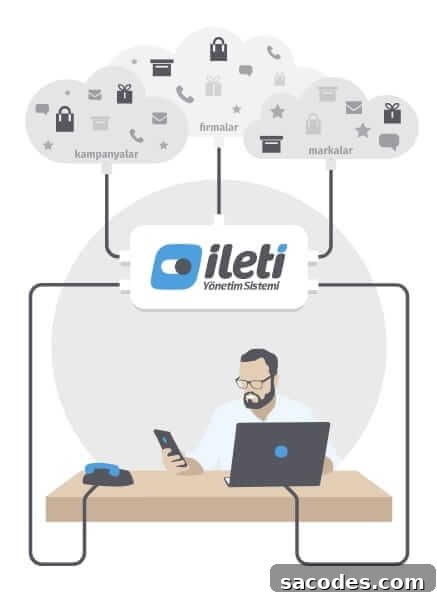
The Message Management System (İleti Yönetim Sistemi) is designed as a secure, national database where service providers can store and manage recipients’ permissions for different types of communications—such as phone calls, text messages, and email. The system enables recipients to view and withdraw the permissions they have granted, and to file complaints about unsolicited messages. It also provides public authorities with the ability to view complaint records and the status of related consents, improving the speed and accuracy of regulatory oversight. All consent records in the system are time-stamped and securely archived to provide an auditable trail.
By centralizing consent management, the system removes the need for consumers to contact each individual service provider to revoke permissions. It also helps businesses verify consent before sending commercial messages, reducing the risk of unintentional violations. For regulators and enforcement bodies, the centralized database shortens investigation timelines because consent records and complaint histories are readily accessible in a standardized format.
Practically, the system operates through multiple channels—web portal, short message number, and call center—so both consumers and businesses have convenient access. Service providers can check whether a recipient has a valid consent for a particular communication type before sending messages. Recipients can manage their own preferences, exercise their right to opt out, and submit complaints when they receive unauthorized communications. All actions are recorded with timestamps to ensure transparency and accountability.
The benefits of a national message management system include stronger protection of consumer privacy, more efficient compliance for businesses, and faster regulatory response to complaints. By creating a unified and secure mechanism for recording and managing consent, the system promotes trust in electronic commerce while ensuring that commercial communications are conducted with the clear, demonstrable consent of recipients.
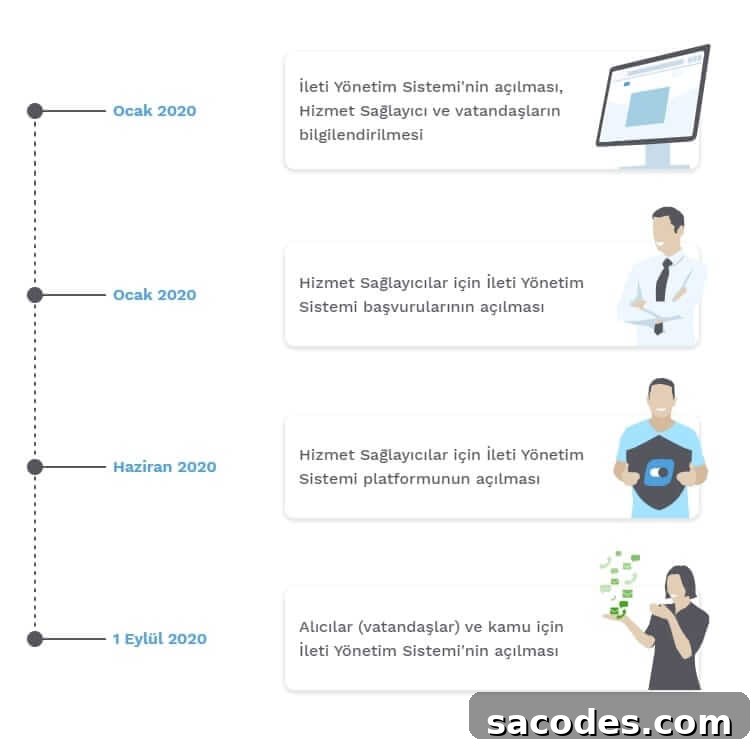
Timeline
Source: iys.org.tr