
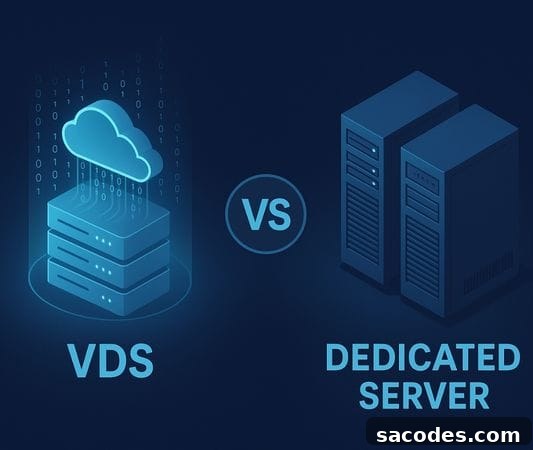
As web projects grow, a business’s hosting needs become increasingly complex. At this point, users typically choose between two main options: VDS (Virtual Dedicated Server) and Dedicated Server (Physical Server). Both solutions promise high performance and flexibility, but differences in cost, management, and suitability for different project types create distinct advantages and trade-offs.
In this article, we will examine the technical differences between VDS and Dedicated servers, compare their performance and cost, and explain which solution is more advantageous under various circumstances.
What Is a VDS? The Flexible Side of Virtualized Power
VDS, or Virtual Dedicated Server, is a hosting solution created by partitioning a physical server into multiple independent servers using virtualization technology. Each VDS runs as an isolated environment with its own operating system, allocated resources (RAM, CPU, disk, bandwidth, etc.), and root access.
Multiple users share the same physical hardware, but the virtualization layer ensures each user has access to dedicated resources. Compared to a standard VPS (Virtual Private Server), a VDS typically provides greater performance, control, and security.
Key Advantages of VDS
→ Flexibility: Resources are managed in software, so CPU, RAM, or disk space can be increased quickly when needed.
→ Cost Efficiency: Compared to renting a physical server, VDS delivers high performance at a significantly lower cost.
→ Fast Provisioning: Virtual machines can be ready in minutes without the need for physical setup.
→ Isolation: Each VDS operates independently, so other users’ workloads do not directly affect your environment.
→ Full Control: Root access is provided, allowing custom security configurations and administrative control.
Disadvantages of VDS
Although powerful, VDS solutions do not offer absolute hardware control. Because physical resources are shared, the host machine’s overall performance can be indirectly affected by the load of other VDS instances. For projects requiring extremely high processing power, obtaining the same level of consistent performance as a dedicated physical server can be challenging.
What Is a Dedicated Server? The True Owner of Physical Power
Dedicated Server refers to a physical server whose entire hardware resources are allocated to a single user. In this model, CPU, RAM, storage, and network bandwidth are used exclusively by that customer.
This setup is ideal for projects that require full hardware control, maximum performance, and heightened security. Large-scale websites, enterprise ERP systems, and high-traffic e-commerce platforms often choose dedicated servers.
Key Advantages of Dedicated Servers
→ Maximum Performance: Since resources are not shared, performance is consistent and predictable.
→ Full Hardware Control: Hardware components (disk type, processor, RAM capacity) can be fully customized.
→ Enhanced Security: Data access is exclusive to the user, and the absence of shared virtual environments reduces certain attack vectors.
→ Suitable for Large-Scale Projects: Ideal for systems that process large volumes of data and require intensive computation.
Disadvantages of Dedicated Servers
Allocating an entire physical machine to one user increases costs. Hardware upgrades require physical intervention, which can cause downtime. Energy consumption, maintenance, and management expenses are generally higher compared to VDS solutions.
Technical Differences Between VDS and Dedicated Servers
| Feature | VDS | Dedicated Server |
|---|---|---|
| Resource Type | Virtualized | Physical |
| Performance | Medium – High | Maximum |
| Flexibility | High | Medium |
| Management Ease | Easy | Moderate – Difficult |
| Provisioning Time | Minutes | Hours |
| Cost | Low – Medium | High |
| Security | Depends on virtualization layer | Hardware-level |
| Upgrades | Fast and software-based | Requires physical intervention |
According to this comparison, VDS is a more dynamic and cost-effective option, while a Dedicated Server delivers full hardware power and is better suited for large-scale projects.
Performance Comparison
Performance is often the most critical factor when choosing a server. Modern VDS platforms, powered by advanced virtualization technologies such as KVM, VMware, or Virtuozzo, can deliver very high performance. However, because physical resources are shared, a VDS cannot always match the consistency of a fully isolated Dedicated Server.
For example, a database running on a dedicated server for a data-intensive ERP will generally provide faster query response times and lower latency compared to the same database on a VDS. On the other hand, for a medium-sized website, that difference is often negligible.
Security and Isolation
Security is a priority for businesses that host sensitive corporate data. A Dedicated Server provides complete isolation because all hardware resources belong to a single user, which significantly reduces certain risks from external attacks.
VDS platforms rely on the hypervisor and virtualization layer as an additional security boundary. While this introduces potential vulnerabilities—such as hypervisor exploits or risks related to resource sharing—these risks can be largely mitigated through regular updates, secure configurations, and best practices.
Management and Scalability
VDS offers a scalable hosting model. Resources can be increased instantly as demand rises, making it behave similarly to cloud architectures.
In contrast, scaling a Dedicated Server typically requires hardware changes or adding components, which can prolong operational procedures.
For growing businesses that haven’t yet reached fixed resource limits, a VDS provides a flexible infrastructure that can expand with demand.
Cost Analysis and Return on Investment
Dedicated Server solutions require a higher initial investment and ongoing maintenance costs due to the exclusive allocation of physical resources. Hardware and energy costs directly affect the total budget.
Conversely, VDS services run on shared physical infrastructure and are therefore more affordable. This makes VDS an attractive choice for small and medium-sized businesses seeking high performance on a budget.
If your project doesn’t yet require the full capacity of a physical server, choosing VDS is often a sensible economic and technical decision.
When to Choose Which?
-
When to Choose VDS:
- Medium-sized websites, blogs, news portals
- Test environments or developer servers
- Projects that grow dynamically
- Businesses seeking high performance on a limited budget
-
When to Choose a Dedicated Server:
- Large-scale e-commerce platforms
- Systems with high traffic and heavy data processing needs
- Organizations with strict, custom security policies
- Businesses that require maximum control in the data center
Whether you choose VDS or a Dedicated Server, high performance cannot be realized without correct configuration and management. Therefore, working with an experienced hosting provider or managed service specialist is essential to ensure the chosen infrastructure meets your project’s technical and operational needs.