
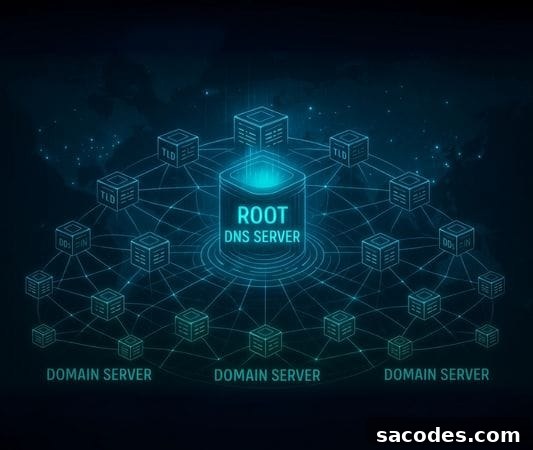
One of the most critical components that keeps the internet running smoothly is the Domain Name System (DNS). DNS translates memorable domain names (for example: example.com) into IP addresses that computers can use. At the top of this translation hierarchy are the Root DNS servers, which provide the starting point for nearly every DNS lookup on the global internet.
Root DNS servers act as the initial reference in the DNS “phone book.” When a user types a domain name into a browser, the resolution process begins at the root level. For that reason, root servers form the backbone of global internet infrastructure and are essential for DNS resolution and overall connectivity.
Primary Role of a Root DNS Server
Root DNS servers do not directly return the final IP address for most domain names. Instead, their primary function is to indicate which Top-Level Domain (TLD) server (for example, the .com servers) should be queried next. In a typical lookup for www.example.com the sequence is:
→ The DNS resolver queries a root server.
→ The root server responds with the address of the appropriate TLD server (e.g., the .com TLD).
→ The resolver then queries that TLD server to learn which authoritative name server holds information for example.com.
→ Finally, the resolver asks the authoritative server for the domain’s IP address.
In other words, root servers play the role of the first router in the DNS resolution chain, directing queries toward the correct TLD servers.
How Many Root DNS Servers Are There?
There are 13 distinct root server identifiers in the DNS naming system, labeled A through M (A-root, B-root, C-root, … M-root). These 13 identifiers are managed by different organizations, including ICANN and various research and academic institutions.
- Although there are only 13 named root server identities, those identities correspond to hundreds of physical servers.
- Anycast routing technology enables each root server identifier to be served from many locations worldwide, improving both performance and resilience.
- This distributed model delivers major advantages in speed, redundancy, and security by keeping services close to users and making single points of failure extremely unlikely.
Why Root DNS Servers Matter
Root DNS servers are indispensable for the modern internet. They:
- Initiate the first step in domain name resolution.
- Represent the highest level of the DNS hierarchy.
- Play a vital role in the stability and security of the internet.
A successful attack that disrupts root servers could seriously impair global access to websites and online services, so these servers are protected with extensive security measures and constant monitoring.
Security Measures Protecting Root DNS Servers
Root servers are among the most heavily secured components of the internet. Key protections include:
- Anycast routing, where thousands of servers share the same root identity across multiple locations, making it difficult to target a single instance.
- DNSSEC (Domain Name System Security Extensions), which helps prevent spoofing and ensures the authenticity of DNS responses.
- Continuous monitoring and intrusion detection/prevention systems (IDS/IPS) that detect and mitigate abnormal traffic patterns and attacks in real time.
Thanks to these layered defenses, root servers are designed to remain available 24/7 despite attempts to disrupt them.
Who Operates Root DNS Servers?
Different institutions operate the named root servers. Examples include:
- A-root → ICANN
- B-root → USC-ISI (University of Southern California)
- C-root → Cogent Communications
- D-root → University of Maryland
- E-root → NASA Ames Research Center
This operational diversity prevents any single organization from controlling the entirety of the DNS root layer and helps maintain a distributed, resilient infrastructure.
What If Root DNS Servers Failed?
If root servers were to become unavailable, new DNS queries would fail, and internet access would be severely disrupted. However, DNS caching would allow access to previously resolved domain names for a limited time. Without functioning root servers for an extended period, global internet functionality would degrade significantly, which is why maintaining root server availability is treated as a top priority by the internet community.
In summary, the Root DNS server layer is one of the foundational components that enable DNS resolution and, by extension, internet connectivity. By pointing resolvers toward the correct TLD servers and being protected with anycast, DNSSEC, and strong operational practices, root servers ensure that billions of users can reliably access online resources every day.