
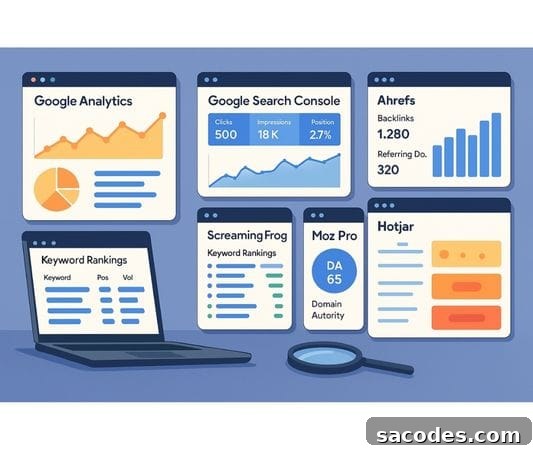
One of the most critical factors for success in the digital world is SEO (Search Engine Optimization). But SEO is not just about finding the right keywords or producing content. The most important part of the process is analyzing and measuring the work that has been done. This is where SEO analytics tools come into play.
So, which analytics tools for SEO should you use, and what advantages do each of them offer?
The Importance of Analytics Tools in SEO
A solid SEO strategy isn’t just about creating content; it’s about knowing:
-
Which pages attract the most traffic,
-
How users behave on your site,
-
Which keywords your competitors rank for,
-
Which backlinks actually carry value.
Analytics tools provide answers to these questions for SEO specialists and businesses. In short, success in SEO requires not only producing content but also measuring, analyzing, and optimizing your efforts.
Google Analytics: The Heart of Organic Traffic
Google Analytics is the most widely used tool for measuring SEO performance.
Key benefits:
-
Organic traffic sources are shown in detail.
-
It tracks which pages users land on and how long they stay.
-
Bounce rate provides insight into user experience.
-
By setting goals and conversions, you can measure SEO’s impact on business outcomes.
Without Google Analytics, monitoring SEO performance becomes nearly impossible.
Google Search Console: The Key to Search Visibility
Google Search Console is one of the most important technical tools in the SEO toolkit.
-
It shows which keywords are generating clicks.
-
It tracks page indexing status.
-
Mobile usability issues are reported.
-
Detailed information on crawl errors and sitemaps is available.
For example, if a page appears in Google search results but receives few clicks, Search Console helps you identify the issue so you can optimize titles or descriptions.
Ahrefs and SEMrush: Competitor Analysis and Keyword Research
Succeeding in SEO without analyzing competitors is difficult. That’s where Ahrefs and SEMrush come in.
-
Keyword research: Discover which keywords can potentially drive traffic.
-
Competitor analysis: Examine competitors’ backlink profiles and traffic sources.
-
Backlink tracking: Report new or lost links.
-
Content gap analysis: Find keywords your competitors rank for that you don’t.
Ahrefs’ extensive backlink database and SEMrush’s thorough keyword difficulty metrics are both critical to strengthening an SEO strategy.
Screaming Frog: The Technical SEO Crawler
A strong content strategy is not enough if your technical SEO is weak. If the technical foundation is not sound, your content won’t appear in search engines.
Screaming Frog is a popular crawling tool used by SEO professionals.
-
Broken links (404 errors) are detected.
-
Missing title tags and meta descriptions are identified.
-
Duplicate content issues are found.
-
Redirect chains are analyzed.
It’s indispensable for spotting technical issues, especially on large e-commerce sites.
Moz and Majestic: Backlink Quality Analysis
Backlinks are one of the strongest ranking factors in SEO. But backlink quality matters as much as quantity.
-
Moz: Measures site authority with metrics like Domain Authority (DA) and Page Authority (PA).
-
Majestic: Analyzes backlink trustworthiness with Trust Flow and Citation Flow metrics.
These tools help you understand not just how many backlinks you have, but which links actually contribute to SEO performance.
Hotjar and Crazy Egg: User Experience and Heatmaps
SEO isn’t just for search engines — it’s also about user experience. If users arrive on your site and leave quickly, that negatively impacts SEO.
Hotjar and Crazy Egg visualize user behavior through heatmaps.
-
They show where users click,
-
Which sections of a page hold attention,
-
And where users abandon the site.
These insights guide optimizations ranging from content layout to the placement of CTAs (call-to-action buttons).
Turning Data into Strategy
Using analytics tools alone is not enough. The real value comes from converting the collected data into an actionable SEO strategy.
Examples:
-
If Google Analytics shows pages with high traffic but low conversions → revise the content or calls to action.
-
If Ahrefs reveals keywords where competitors perform well → create focused content for those keywords.
-
If Search Console reports low click-through rates → optimize meta descriptions and titles.
When the insights provided by SEO analytics tools are monitored regularly and turned into concrete actions, they drive measurable results.
SEO analytics tools can be grouped into the following categories:
-
Google Analytics: Traffic and user behavior analysis
-
Google Search Console: Technical SEO and search visibility
-
Ahrefs / SEMrush: Keyword and competitor analysis
-
Screaming Frog: Technical site crawling
-
Moz / Majestic: Backlink quality evaluation
-
Hotjar / Crazy Egg: User behavior and experience analysis
Using these tools together strengthens your SEO strategy because SEO is not just about content — it’s a data-driven optimization process that relies on ongoing measurement, analysis, and improvement.