
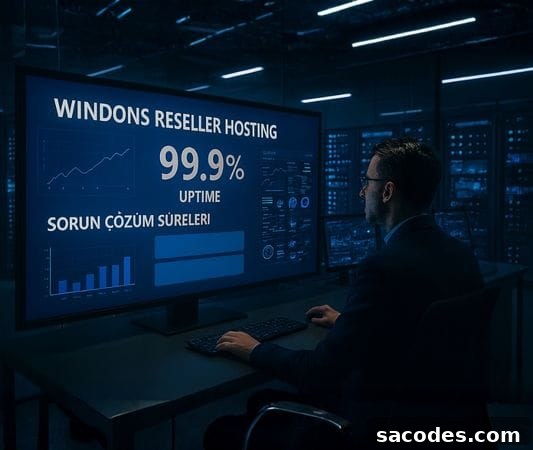
Windows Reseller Hosting is a professional infrastructure solution that enables web service providers or agencies to offer hosting services to multiple clients under their own brand. This model provides high control, scalability, and performance, especially for digital agencies, web developers, and technical service providers. The success of this approach depends heavily on two critical factors: uptime guarantees and issue resolution times.
In this article, we will examine in detail how uptime rates are measured in Windows Reseller Hosting, how issue resolution processes are managed, and how these factors affect the customer experience. We will also provide in-depth information on the technical methods hosting providers use during these processes.
What Is an Uptime Guarantee and Why Does It Matter?
Uptime refers to the period a server or hosting service remains online without interruption. It is usually expressed as a percentage. For example, a 99.9% uptime guarantee means the system may be offline for about 8.76 hours over a year.
This metric is a primary measure that directly impacts customer satisfaction in a Windows Reseller Hosting setup. Since resellers deliver services under their own brand, any downtime is not only a technical problem but also damages brand credibility.
The importance of an uptime guarantee can be summarized as follows:
-
Reliability: Continuous service builds customer loyalty.
-
SEO Performance: Sites that remain consistently accessible tend to rank higher in search engines.
-
Corporate Image: Strong uptime management demonstrates technical competence and professionalism.
How Is Uptime Guaranteed in Windows Reseller Hosting?
A Windows-based reseller hosting infrastructure uses a range of technical optimizations and infrastructure management strategies to achieve its uptime commitments.
⊕ High Availability Architecture
Modern hosting providers ensure service continuity with load balancing and failover mechanisms. Typical features include:
-
Automatic traffic rerouting to other active servers when one fails.
-
Redundant data storage with RAID configurations to prevent data loss from hardware failures.
-
Virtualization platforms such as Microsoft Hyper-V or VMware that support live migration.
This type of architecture can provide uptime guarantees typically in the 99.95% – 99.99% range.
⊕ Continuous Monitoring and Proactive Intervention
Modern Windows servers like Windows Server 2022 are monitored 24/7 with tools such as Event Viewer, Performance Monitor, and System Center Operations Manager (SCOM). This enables:
-
Early detection of anomalies in CPU, RAM, and I/O usage.
-
Resolution of network interruptions or DNS issues before users are affected.
-
Maintenance of service continuity via automatic recovery and restart policies.
⊕ The Role of Data Center Infrastructure
Uptime depends not only on software but also on the physical data center infrastructure. Key factors include:
-
Tier IV data center standards
-
Redundant power supplies (UPS plus generators)
-
N+1 cooling systems
-
Geo-redundancy
These measures support continuity even in extreme events such as natural disasters or prolonged power outages.
What Are Response and Resolution Times?
When evaluating a hosting provider’s performance, it is important to consider not only uptime but also issue resolution times. These are commonly measured by two metrics:
-
Response Time: The time it takes for support to respond to a customer ticket or alert.
-
Resolution Time: The total time required to fully resolve the issue.
These metrics are usually defined within the SLA (Service Level Agreement).
Factors That Affect Issue Resolution Times in Windows Reseller Hosting
1. Support Structure
Many providers offer 24/7 support and multiple communication channels (tickets, phone, live chat). However, the primary factor that determines resolution speed is the technical competence of the support team.
-
Level 1 Support: Handles basic configuration and access issues.
-
Level 2 Support: Investigates service-level faults such as DNS, email, and FTP problems.
-
Level 3 Engineering: Deals with server configurations, IIS, and MSSQL issues.
This tiered approach ensures problems are escalated to the correct level and helps reduce average resolution times.
2. Automated Diagnostics and Self-Healing Systems
Windows environments can run automated remediation scenarios using PowerShell scripts and Windows Admin Center. For example, if an IIS Application Pool crashes, the system can automatically restart that pool.
Such automation reduces the need for manual intervention and significantly lowers mean time to repair (MTTR).
3. Monitoring and Notification Automation
Automated alerting is critical to efficient issue resolution. Modern reseller infrastructures commonly include:
-
Email or SMS alerts to notify administrators instantly.
-
SNMP protocols to centrally report network device faults.
-
AI-assisted analytics that learn from past logs and suggest preventive maintenance.
These systems help resolve issues before customers notice them.
The Relationship Between Uptime Guarantees and SLAs
Many providers include specific SLA terms in their Windows Reseller Hosting packages. Common SLA elements are:
-
99.9% uptime guarantee
-
Response times under 15 minutes
-
Commitment to resolve issues within 4 hours
An SLA is a contractual performance commitment for both the customer and the provider. Unmet guarantees may entitle customers to service credits or refunds.
Therefore, an uptime guarantee is not just a technical target but also a contractual obligation.
Most Common Causes of Issues in Windows Reseller Hosting
Despite efforts to maximize uptime, outages may still occur. Knowing the common causes helps speed up resolution:
⊗ DNS misconfigurations — Incorrect domain resolution prevents access to sites.
⊗ IIS configuration errors — Application pool failures or misbindings can stop services.
⊗ Database connection failures — Overloaded MSSQL servers can lead to dropped connections.
⊗ Hardware failures — Disk or memory errors threaten uptime guarantees.
⊗ DDoS attacks — Volume-based attacks can degrade or interrupt service.
Using predefined intervention protocols in these situations significantly reduces resolution times.
Best Practices for Incident Resolution
To maximize uptime and streamline incident response in Windows Reseller Hosting, consider these best practices:
-
Implement regular backup policies.
-
Actively use monitoring tools (e.g., Zabbix, PRTG).
-
Centralize log management.
-
Review SLA performance reports monthly.
-
Provide detailed technical information when submitting support requests.
These steps not only resolve current issues but also help prevent future outages.
Criteria to Consider When Choosing Windows Reseller Hosting
When selecting a reseller hosting provider, in addition to uptime and incident response performance, evaluate these technical aspects:
-
Server location: Data centers close to your target audience reduce latency.
-
Control panel: Windows-compatible panels like Plesk or DirectAdmin make management easier.
-
Resource allocation: Clear definitions for CPU, RAM, and disk usage limits.
-
Support channels: 24/7 active support systems make a critical difference during incidents.
A well-structured Windows Reseller Hosting environment—built on high availability, professional support, and robust infrastructure—serves as a strategic solution for digital service providers. To ensure sustainable performance, uptime guarantees must remain high and incident resolution processes must be managed effectively.
Uptime and resolution times are not just technical metrics; they directly affect brand reliability, customer satisfaction, and operational efficiency. When choosing hosting infrastructure, evaluate not only hardware capability but also SLA quality, the effectiveness of monitoring systems, and the professionalism of technical support.
A properly configured Windows Reseller Hosting infrastructure delivers uninterrupted service and high user satisfaction, strengthening a brand’s digital credibility over the long term.