Family
Single Parents: A Briefing on Grants
Parenthood can be a joy and is undoubtedly one of life's most rewarding experiences. However, it can also be stressful. This is especially true for single parents, who must juggle

On top of the emotional and physical stress that single parenting brings, it also contributes to financial hardships. A single-parent household only has one income stream, which can make money tight. If you're a solo mother or father, the combination of providing for your little one's day-to-day needs, along with planning for their future (like college), can be nerve-wracking. The cost of going to college is rising, while inflation is increasing everyday living costs. It's overwhelming, to say the least.
The good news? There is assistance offered. For instance, if you want to further your education to secure a brighter future for yourself and your family, there are financial grants to help. There are also plenty of support resources to help the many single parents who are caring for their kids while obtaining an education. While being a single parent in college or university might feel lonely at times, you definitely aren't in this alone. There are others like you. Need proof?
Here's some fast facts on single parents who are studying:
- The United States has the world's highest rate of children living in single-parent households.
- In 2020, there were about 15.21 million U.S. children living with a single mother and 3.27 million living with a single father.
- Of the 20 million college students in the U.S. enrolled during the 2019-2020 academic year, 4.3 million were raising a child.
- Four million U.S. undergraduate students are raising kids while completing their postsecondary education.
- Over a quarter (26%) of all undergraduate students are raising dependent children.
- 54% of single mothers in college work 20 or more hours per week and 43% work 30 or more hours per week.
- The proportion of academic institutions providing child care has decreased from 59% to 45% from 2004 to 2019.
- 41% of all student parents have incomes that fall below the Federal poverty line.
- Single mothers with college degrees are less likely to live in poverty, with poverty rates averaging 33% less for each extra level of education.
- Women hold an average of $31,276 in student debt.
- Women graduating with a bachelor’s expect to earn $35,338 on average — 81% of what men expect to earn.
- One year after college, the 16% of women who are moms expect to spend $520 per month on childcare, making loan repayment difficult.
- 61% of student fathers drop out of college without degrees, compared to 48% of student mothers. Among single, Black, and Latino fathers, the dropout rate is about 70%.
- Single parents are more likely to face time pressures — juggling child care, work, and school — and are at a higher risk of dropping out. The COVID-19 pandemic exacerbated this trend.
- Research shows that the COVID-19 pandemic put the most stress on single-parent households.
- So-called "time poverty" is the most significant for moms of preschool-age kids, per a 2021 survey of 11,195 college students in the U.S.
How many single parents are in college?
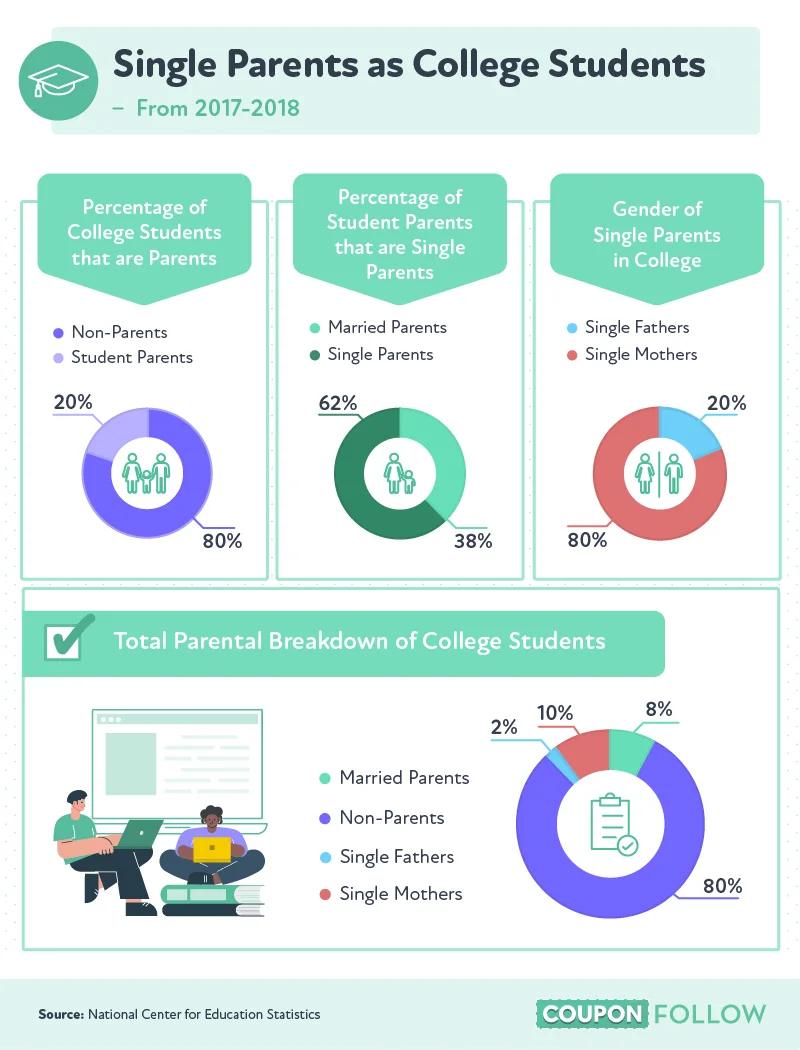
Per an analysis of National Center for Education Statistics data conducted by the Institute for Women's Policy Research and the ASCEND, 22% of college students are parents. Of those, 45% are single parents — and of those, 79% are single moms. The number of single mothers studying is even higher for Black women, who are more likely to be parenting solo than their white or Hispanic counterparts.
3 grants for single parents
The facts are clear: Single parents in college face unique hardships. The need to care for kids while making time for studies — and, often, holding down a job at the same time — results in so-called "time poverty." On top of that, many student parents (41%) live in actual financial poverty. Affording tuition and books, on top of day-to-day living expenses for an adult and a child, leaves single parents who are studying stretched thin. These grants can help.
Federal pell grant
Pell Grants make up the largest student aid program in the U.S. This is a need-based (not merit-based) form of financial help that grants recipients money to put towards tuition, books, and other college-associated expenses. The amount of the grant depends on the determined need along with the costs of the applicant's educational institution, and whether the applicant is studying full or part-time. The maximum amount awarded for a Pell Grant was $6,495 from 2021 to 2022.
To qualify for this grant program, you must be already enrolled in a college or university (full or part-time) and show financial need. This is done by completing the FAFSA, Free Application for Federal Student Aid. To complete the FAFSA, you'll need basic identifying and financial details, like your social security number or alien registration number, federal income tax returns, and bank statements and records.
Best for: Students with basic needs.
Federal supplemental education opportunity grants
The Federal Supplemental Educational Opportunity Grant, FSEOG, is given to students who demonstrate the "highest levels" of need. FSEOG is given to people who have been awarded a Pell Grant and still need extra funds. This supplemental grant can range from $100 to $4,000 each year drawn from the demonstrated need and availability of funds (2021 to 2022 figures).
To qualify for a FSEOG supplemental grant, you simply need to complete the FAFSA. Drawn from the FAFSA, you may be awarded a Pell Grant and the supplemental FSEOG. The U.S. Department of Education’s Office of Federal Student Aid provides participating schools with a set amount of FSEOG money every year. Once the FSEOG money has been distributed, there isn't any more for that year. In contrast, the Pell Grant awards funds to all who meet the eligibility requirements.
Best for: Students with extreme need and limited or no familial contribution.
State grants
The above grants are both federal grants. However, there are also state government grants. For instance, Virginia has the Virginia Tuition Assistance Grant, VTAG, which helps Virginia residents who attend accredited, private, nonprofit educational institutions in the state (funding of up to $4,000 for undergraduates and $2,200 for graduate students).
Meanwhile, in New York, the New York State Tuition Assistance Program (TAP) helps residents pay tuition at approved schools in the state. An annual award can be up to $5,665. In California, the California Student Aid Commission provides students in need with financial support through the Cal Grant Equity Framework. Cal Grant awards are tiered per need and institution. For instance, a student studying at a California State University can get up to $5,472 towards tuition and school costs.
The best way to discover state-specific financial assistance providers is through your state's Department of Education. The National Department of Education has a state-by-state database with a site and contact details of departments of education across the country. Check it out.
Best for: People attending a school within their home state of residence.
Extra funding choices for single parents
Governmental funding is just one choice for single parents. There are plenty of other choices regarding getting together the money for studies while maintaining a family. Here are a few ideas to get you started.
Apply for school-issued or private scholarships
Many colleges and universities have school-specific scholarships issued by the institution (often with the help of an external donor). There are also private scholarships funded by philanthropists supporting education. Contact your college or university's relevant financial aid and scholarship office for details about what may be applicable at your school. Sometimes, scholarships link to a certain degree program. Examples of such scholarship funds include:
- The Answer Scholarship is awarded to "nontraditional" female students aged 25 and up who are the primary caregiver of at least one school-aged child.
- The Capture The Dream Scholarship awards scholarships to low-income single parents who are also Bay Area residents.
- The Soroptimist Live Your Dream program awards scholarships to women who have overcome extreme hardships, including poverty, domestic violence, and teen pregnancy.
- The Beatrice F. Kroesche Memorial Scholarship is awarded to single parents attending the University of Utah who are enrolled in the Department of English or College of Education.
- The Downer-Bennett Scholarship is awarded to a single parent attending the main campus of the University of New Mexico.
- The Kathleen McVey Memorial Scholarship is awarded to a college student enrolled in the RN or LVN program at the College of the Redwoods.
Consider ways to earn extra income
Another way to offset your financial woes as a single parent who's studying is to bring in more money. This doesn't mean you have to go work a full-time job. You might work part-time, freelance for extra cash, or even arrange a small business. Here are some resources to help you find a suitable gig:
- For part-time work, use a job search engine like Indeed, specifying "part-time" and your location (or, you can specify "remote").
- For freelancing, check out work-for-hire platforms like Upwork, where you can advertise services from copywriting to accounting, depending on your skills.
- If you're thinking of starting a home-based business, this roundup of business ideas for stay-at-home parents from The Balance can inspire you.
Look into online college or community college
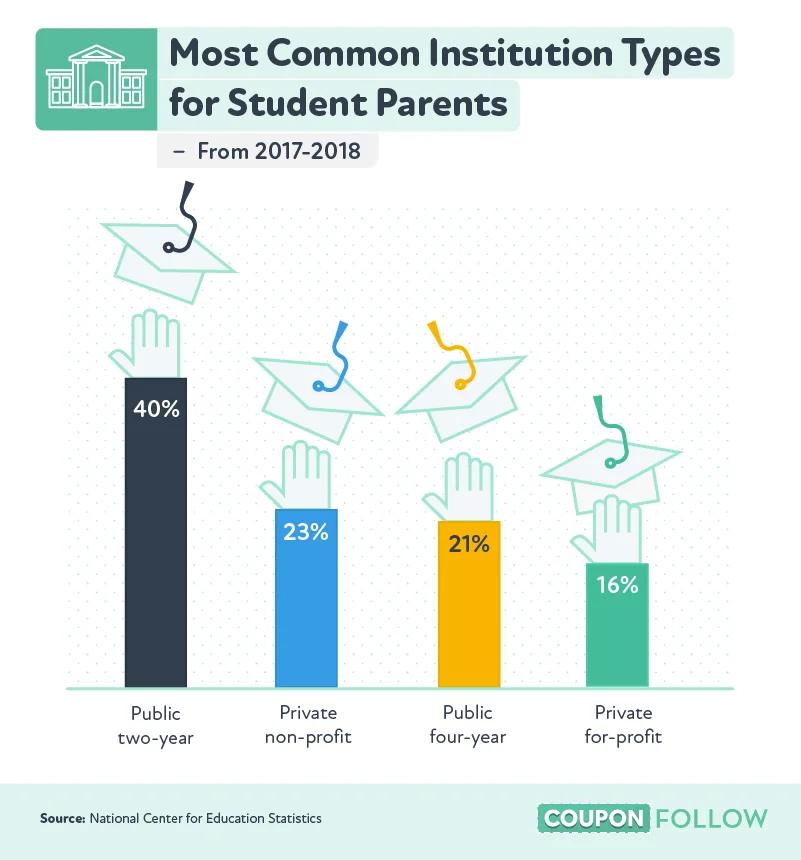
Schools are increasingly offering online coursework and degrees. An online program provides added flexibility, letting you call the shots on when and where you learn. This list of accredited online colleges can help you find a fitting program. A local community college is another choice for more low-priced and flexible studies — these schools often offer night classes to accommodate workers and parents. Learn about your choices here.
Look into part-time
If you're struggling financially — or dealing with "time poverty" — as a single parent in college or university, you might consider scaling back your studies. A part-time program will free up the hours you need to spend with your little one or work a job. It will still get you the same degree in the end, with less stress. If you do pursue part-time studies, be sure that you're still eligible for grants or scholarships you're considering applying to (some are for full-time students only).
Consider other forms of governmental assistance
Along with student loans and college grants, there is also general government aid designed to help low-income families. For instance, Temporary Assistance for Needy Families, TANF, is a federal program that provides cash assistance to those in need, while the U.S. Department of Housing, HUD, provides housing grants — and the Supplemental Nutrition Assistance Program, SNAP, helps families get access to low-priced food with food stamps. If you're Medicaid eligible, you can benefit from the Children's Health Insurance Program for your kid's health care. Your state likely has some type of private student loan or financial aid program offered for you to consider, too.
4 organizations that support single parents in school
Thriving as a single parent in college requires more than financial assistance. You can also benefit from other types of practical support — like child care — along with emotional support. The great news is, there are organizations to help with these points too! Here's some choices.
The National Center for Student Parent Programs (NCSPP)
The National Center for Student Parent Programs supports college access for student parents by working together with families to improve upward mobility from poverty into the middle class. This organization encompasses a nation-wide network of university and college administrators, along with policy makers, non-profits, and advocates. They provide programs that increase the odds of successful degree completion and foster positive career development.
Child Care Access Means Parents In School (CCAMPIS)
Child Care Access Means Parents in School Program helps provide campus-based child care services, allowing low-income parents to more easily pursue a higher education. Funds are used to establish campus child care assistance services (like daycare) targeting low-income families. Grants can also be used for before and after-school programs.
HOPE Inc.
Helping Other People be Empowered, HOPE, is dedicated to helping single parents break the cycle of poverty. Their offering includes rent assistance, child care assistance, and social services. For instance, a social worker can help you work out ways to get into public housing or explain tax credits you may be eligible for.
Single Parents Alliance of America
The Single Parents Alliance of America, SPAOA, provides help for single parents by giving them details on local housing, government grant programs, and family resources. Enrollment is 100% free for qualifying single parents. The independent not-for-profit also provides single parents with access to discounts and third-party programs.
Find more savings and resources
When you're a single parent who's studying and caring for a child, money can be tight. Trust Sacodes to help you find the deals you need to get by. By saving on everyday items, you'll have more cash to put towards essentials like child care and tuition. From sales to cashback deals, you'll gain access to a mix of savings.
Topics Students