Holidays
Valentine's Day 2026: U.S. shoppers' Plans
Valentine's Day is all about love, but spending can make things a little complicated. Between assorted budgets, gift expectations, and even the decision to celebrate, couples are
Sacodes surveyed over 1,000 U.S. shoppers in relationships to learn how people are balancing romance with real-life finances. Valentine's Day in 2026 is looking more flexible, thoughtful, and low-pressure than ever.
Key Takeaways
- On average, U.S. shoppers plan to spend $87 on their partner but only expect their partner to spend $63 on them.
- 1 in 5 U.S. shoppers in relationships don't plan to celebrate Valentine's Day this year.
- 83% of U.S. shoppers prefer their partner keep more cash on Valentine's Day rather than spend generously (17%).
- U.S. shoppers rank experiences as their top Valentine's Day gifts, with a romantic dinner (61%) and shared experiences like a trip or concert (57%) far outpacing physical gifts.
Who's Spending What And Who's Skipping It Altogether
Regarding Valentine's Day, couples are not always on the same wavelength about spending. Some people are happy to go all out, while others are quietly hoping things stay low-key.
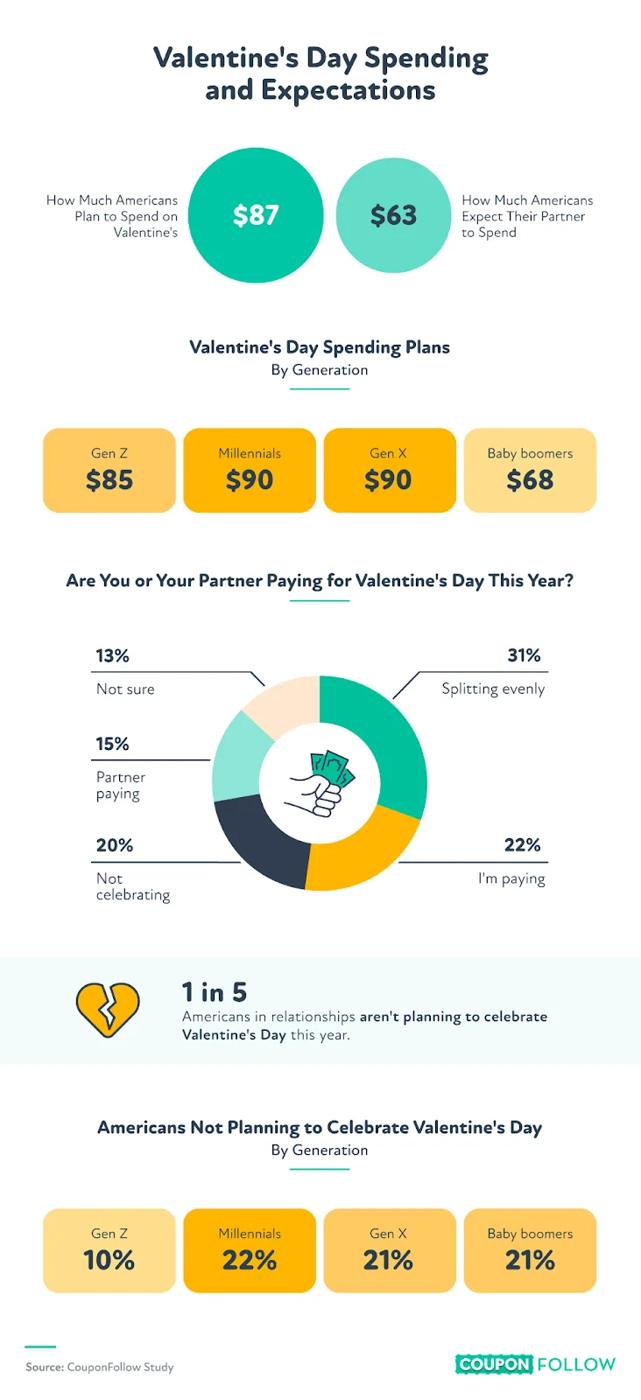
- On average, U.S. shoppers plan to spend $87 on their partner but only expect $63 in return. Men plan to spend 23% more than women ($98 vs. $80), and 45% of men said they'll cover the entire cost, compared to just 6% of women. Women expect more in return: $67 on average, compared with $58 for men.
- Couples in newer relationships (1–3 years) are the biggest spenders, averaging $98, while those together 3–5 years plan to spend only $80. On average, people in relationships say $51 is the minimum someone should spend to show they care. Nearly 1 in 5 believe the threshold is at least $100.
- Spending becomes a red flag around $273, but this varies widely by age. Gen Z tolerates up to $313 before it feels like too much, while baby boomers draw the line at $181.
- Not everyone's celebrating: 1 in 5 U.S. shoppers in relationships don't plan to mark Valentine's Day at all this year.
- Men (44%) are more likely than women (21%) to say they typically spend more on romantic occasions. Gen Z couples are most likely to split costs evenly (46%).
Saving Over Splurging: What Partners Really Want
It turns out plenty of people are perfectly fine skipping the flashy stuff. For many couples, Valentine's Day is more about enjoying time together without stressing over the bill.
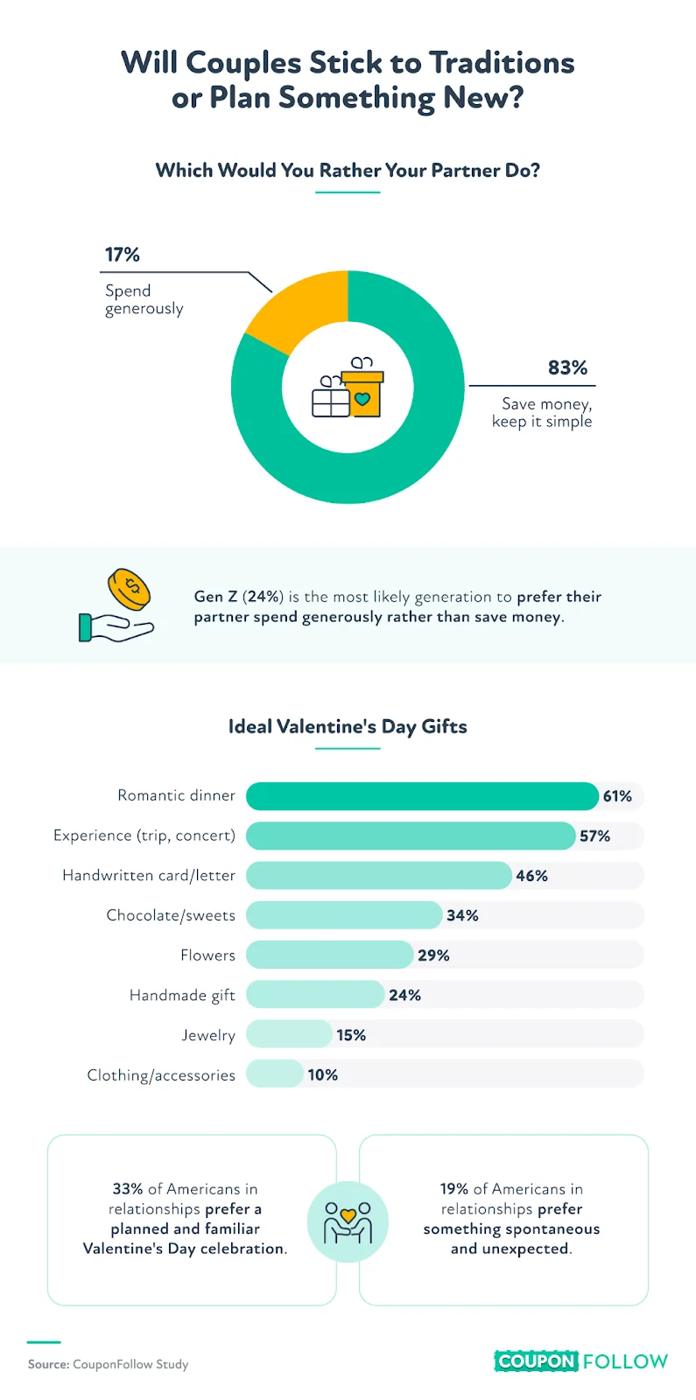
- A resounding 83% of U.S. shoppers said they'd rather their partner spend less and keep it budget-friendly this Valentine's Day than go all-out.
- Men are more into tradition, with 41% preferring "planned and familiar" celebrations, while 34% of women say they have no preference.
- Experiences top the gift list: 61% of U.S. shoppers want a romantic dinner, followed by 57% who prefer shared experiences like a trip or concert. Men's top choice is a romantic dinner (66%), while women prioritize shared experiences (59%).
- Handwritten cards are valued more by women (51%) than by men (39%), with Gen Z U.S. shoppers leading the way in appreciation for heartfelt notes (51%).
- Most U.S. shoppers in relationships (76%) said they plan Valentine's Day together. Only 14% rely on surprises. Men (24%) are more likely than women (7%) to take the lead on planning a surprise. Conversely, 14% of women said their partner typically surprises them, compared to just 5% of men.
What Valentine's Day Looks Like Now
Valentine's Day in 2026 looks a lot more relaxed than it used to. Plenty of couples are spending less, planning together, or even sitting the holiday out entirely. What really stands out is how many people care more about feeling appreciated than being impressed. Whether that means a quiet dinner, a shared experience, or no plans at all, the takeaway is simple. Love does not have to be costly to feel meaningful.
Methodology
We surveyed 1,005 U.S. shoppers in relationships to explore how couples in the U.S. are preparing for Valentine's Day. Among them, 59% were women, and 41% were men. Generational breakdown was: Gen Z (15%), millennials (54%), Gen X (25%), and baby boomers (6%). Data was collected in January 2026.
Topics Gifts