
Overview
Apple Inc. is widely recognized for products that have reshaped consumer technology. Between 2007 and 2023, the company’s product revenue patterns shifted significantly, reflecting changes in market dynamics, consumer preferences, and Apple’s own strategic focus on new hardware categories and recurring services.
Since the iPhone’s debut in 2007, Apple’s product launches have continually diversified the company’s revenue mix. New device categories and an expanding services business have altered the balance between one-time hardware sales and ongoing recurring revenue.
The accompanying infographic summarizes Apple’s product-level revenue from 2007 through 2023 based on the company’s 10-K filings for those years, illustrating how the relative contributions of different product categories evolved over time.
iPhone: The Best-Selling Icon of All Time
When Apple introduced the iPhone in 2007, Steve Jobs called it a “revolutionary product.” In that first year, iPhone sales represented only about 0.5% of Apple’s total revenue. Over the following decade and a half, the iPhone grew from a breakthrough niche product into the dominant force behind Apple’s revenue stream—today accounting for more than half of the company’s product revenue.
Originally launched at $499 and sold exclusively through AT&T in the U.S., the iPhone has become Apple’s most lucrative product line and one of the world’s most widely used smartphones. With over 2.3 billion units sold to date and more than 1.5 billion active users, the iPhone drives a large portion of Apple’s ecosystem—fueling sales of accessories, services, and complementary hardware.
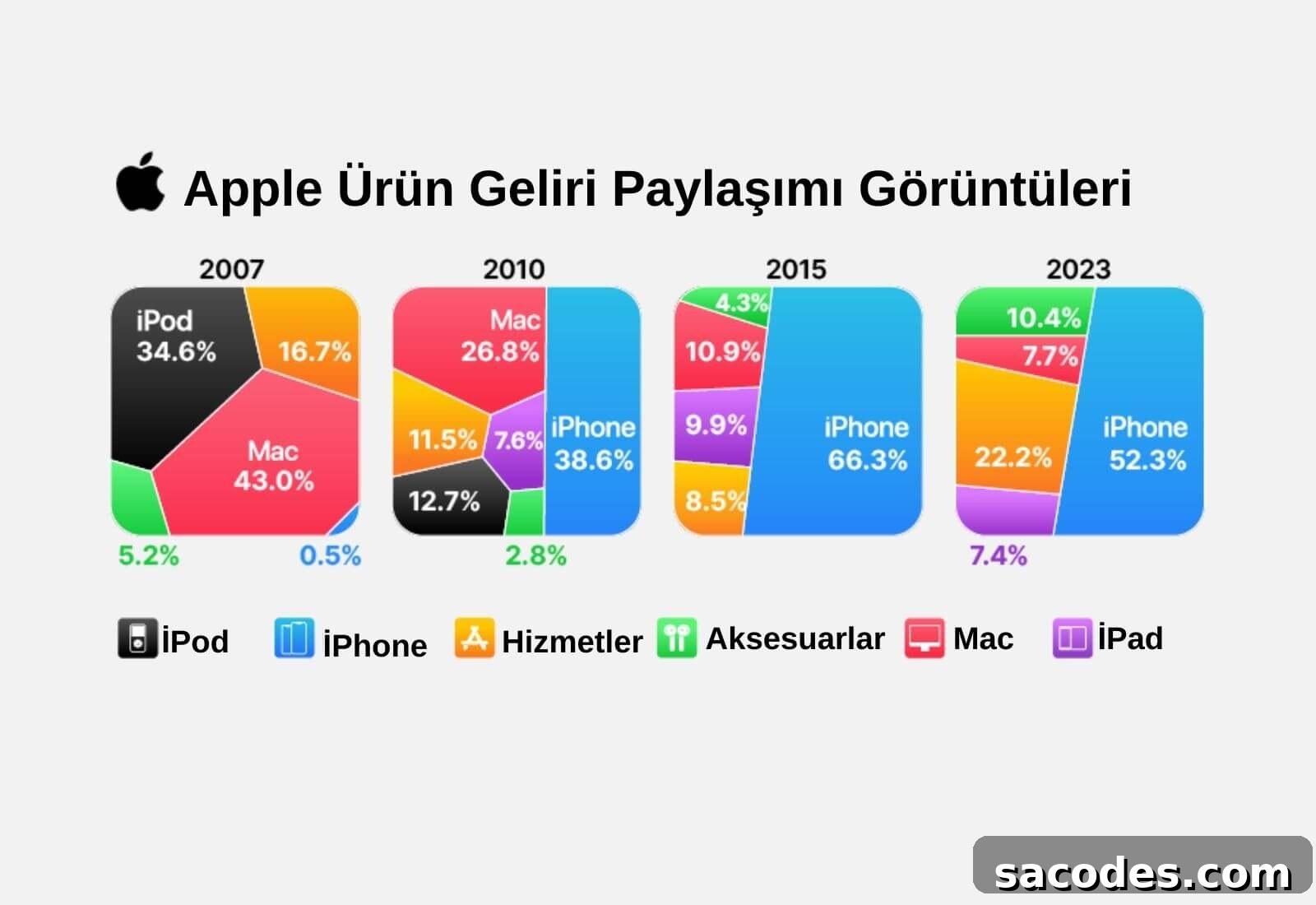
The iPhone’s share of Apple’s product revenue peaked in 2015—coinciding with the widespread adoption of the iPhone 6—reaching roughly 66% of product revenue that year. This concentration emphasised how a single product line can dominate a company’s financials when it meets broad consumer demand.
At the same time, Apple’s product mix looked very different in 2007: Mac computers accounted for about 43% of revenue, while iPods contributed roughly 35%. Over the years, those proportions shifted dramatically as the company introduced new categories and as consumer behavior changed, particularly with the decline in standalone music players and the rise of multifunctional smartphones.
Since about 2015, Apple Services and the Accessories & Wearables category (including products such as the Apple Watch and AirPods) have become increasingly important contributors to the company’s revenue. These segments benefit from attachment to Apple’s installed base of iPhone users, creating recurring and higher-margin revenue streams that complement hardware sales. Despite that growth, Mac revenue declined in 2023—down about 27% from the prior year—reducing the Mac’s share to approximately 8% of Apple’s total revenue.
More recently, the rapid expansion of Services and Wearables/Accessories has begun to moderate, reflecting broader market maturation and cyclical patterns in hardware upgrades. Still, these areas remain central to Apple’s strategy for diversifying income away from single-product dependence and toward a balanced mix of hardware, software, and subscriptions.
Looking ahead, a key question for Apple is whether newer innovations—such as the Apple Vision Pro, a wearable computing platform that projects output directly to the wearer’s eyes and is controlled largely through eye tracking and gestures—will evolve into a consistent, sizable product category and reliable revenue source. The potential for Vision Pro and similar devices to create new use cases, developer ecosystems, and recurring services will be important to watch.
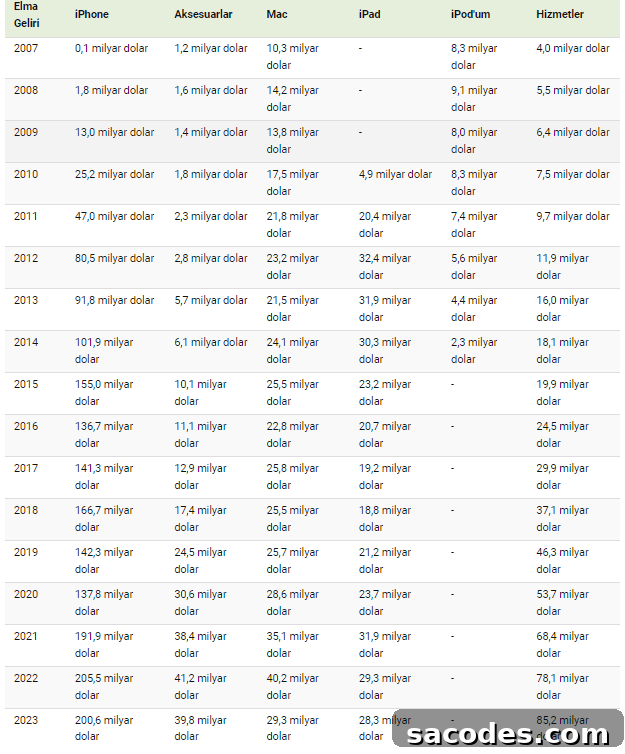
From 2007 through 2023, Apple has demonstrated sustained growth driven by innovation and a user-centered approach to product development. The company’s product revenues reflect its ability to adapt to shifting consumer needs and to expand into new hardware and services categories. While the mix of revenue contributors has changed—moving from Macs and iPods toward iPhones, Services, and Wearables—the underlying strategy of building an integrated ecosystem remains constant. Given Apple’s track record of adapting to evolving technology trends and consumer expectations, the company is positioned to maintain its momentum in the coming years, provided it continues to innovate across devices, software, and services while nurturing the large installed base that supports recurring revenue streams.