Skateboarding’s Evolution Opens the Ride to More Than Teenagers
From homemade boards to Olympic events, skateboarding has kept changing. Safer, beginner-friendly ways to ride could help more adults join in.
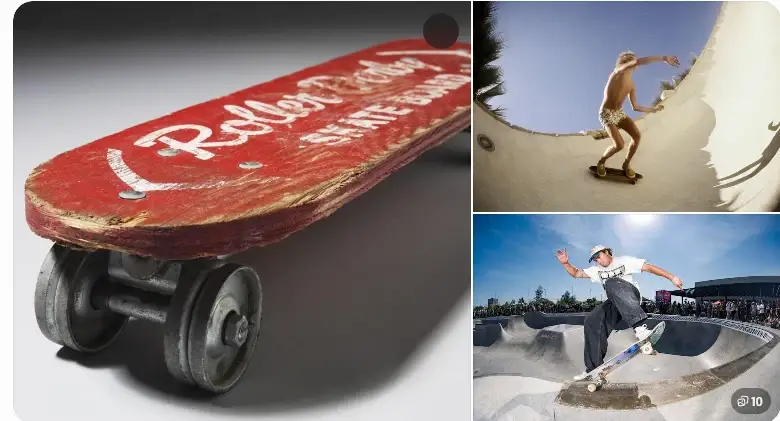
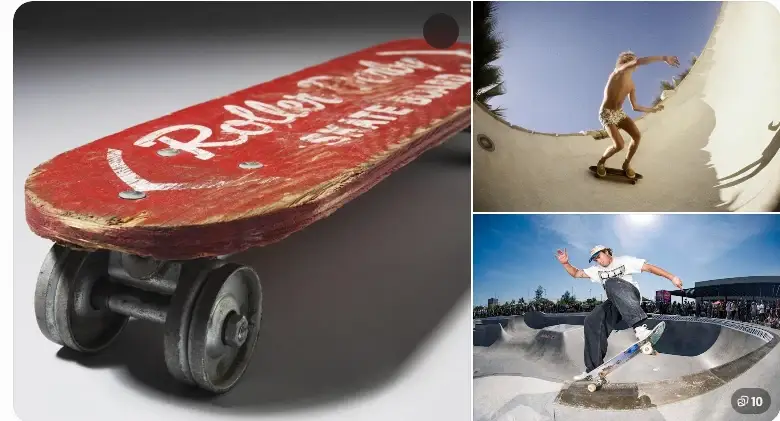
Skateboarding’s staying power comes from its ability to serve different people in different ways. A board can be a tool for tricks, a way to get around, a competitive sport or simply a reason to spend time outdoors. Its history began with surfers looking for a ride when the waves were flat, but the activity now spans generations, equipment types and skill levels.
From homemade boards to a shared invention
There’s no single, universally recognized inventor of the skateboard. The design grew out of experimentation, especially among California surfers in the late 1940s and 1950s. They attached roller-skate wheels to wooden planks, sometimes shaping the boards to resemble small surfboards. The Smithsonian identifies these homemade combinations as the roots of modern skateboarding.
The early boards were basic and tough to control. Metal wheels rattled across pavement and offered little grip; a pebble could stop the board suddenly while the rider kept moving. Still, the idea caught on. Alf Jensen began selling his Bun Board in Hermosa Beach, California, in 1957. Roller Derby introduced mass-produced skateboards in 1959, helping take the pastime beyond homemade equipment.
In the early 1960s, companies including Makaha helped make skateboarding a commercial recreation. Makaha founder Larry Stevenson promoted the sport and helped organize competitions. Boards took on more surfboard-like shapes, and clay wheels offered a change from metal. The activity was becoming a product people could buy, as well as something they could build themselves.
Better wheels and new ways to ride
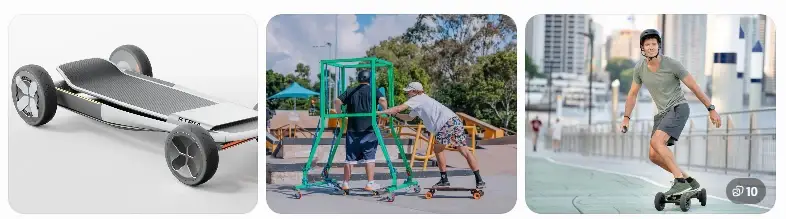
Several design changes altered what riders could do. Larry Stevenson’s 1969 kicktail patent covered the raised end of a skateboard, which lets riders lift the board’s front wheels. That feature helped make more complex maneuvers possible.
In the early 1970s, Frank Nasworthy helped bring polyurethane wheels to skateboarding through his Cadillac Wheels. Softer than the earlier wheels, they provided better traction and a smoother, more predictable ride. More control over different surfaces helped renew interest in skateboarding.
Then came a trick that reshaped the sport. Alan Gelfand developed the Ollie in 1978, allowing a rider to jump with the board without holding it. That ability became central to modern skateboarding tricks.
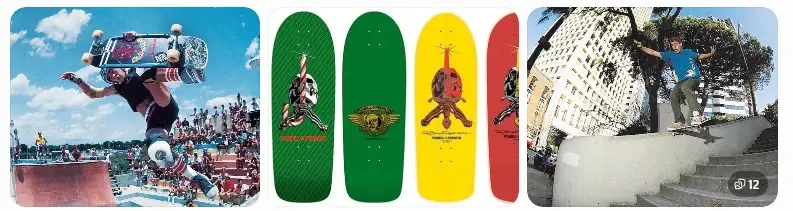
By the 1980s and 1990s, skateboarding had grown into a culture connected with independence, music, fashion and youth. Companies refined decks, trucks, bearings and wheels, experimenting with board shapes, widths, materials and graphics. Street skating turned features such as stairs, rails and ledges into places to ride.
Tony Hawk became known for vert skating and aerial tricks, while Rodney Mullen helped change technical street skating with innovations including the kickflip and heelflip. Their different approaches show how skateboarding can reward both high-flying performance and precise board control.
One name, several kinds of boards
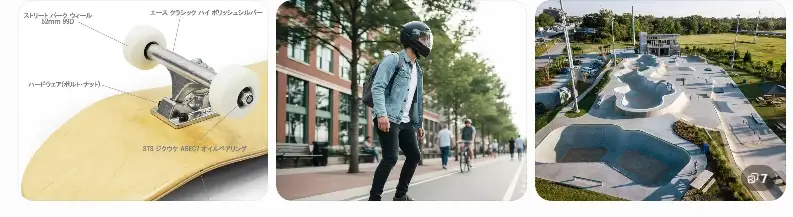
A traditional modern skateboard typically has a deck made from layers of laminated maple, metal trucks, bearings and polyurethane wheels. But there isn’t one ideal setup for every rider. The equipment depends on the kind of riding someone wants to do:
- Street skateboards are built for tricks, jumps, grinding and urban obstacles.
- Longboards are longer and are used for cruising, transportation and downhill riding.
- Cruiser boards are compact options for everyday trips.
- Electric skateboards use motors, so riders can travel without continuous pushing.
- Downhill boards are designed with speed and stability in mind.
This range helps explain why the skateboard has lasted. A person interested in cruising has different needs from someone practicing tricks, and a single design doesn’t have to meet them all.
Riding later in life calls for a different pace
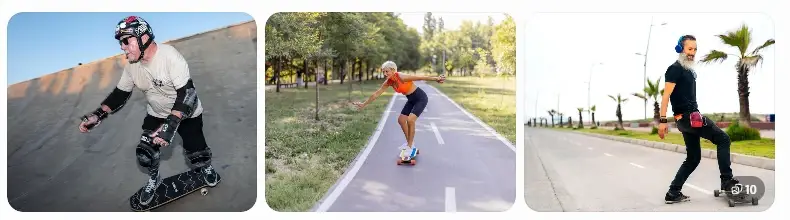
Older adults ride for many reasons: some never stopped, some are returning after years away, and others are learning for the first time. Riding involves balance and coordination, provides physical activity, and asks learners to concentrate and persist. Skateparks can also bring together people of different ages. For some who remember earlier skateboarding booms, getting back on a board has a nostalgic pull.
For an older beginner, gentle riding and learning tricks are very different undertakings. A stable cruiser or longboard, a properly fitted helmet and protective equipment, and practice on a smooth, flat surface are sensible starting points described in the source material. Falls can cause serious injuries, and bones and joints may be more vulnerable with age. Anyone considering a new physical activity can take their health and current ability into account before starting.
The goal doesn’t have to be a kickflip or a halfpipe. Cruising at a comfortable pace is a valid way to enjoy the board, and there’s no need to measure progress against younger or more experienced riders.
Participation, competition and the Olympic stage
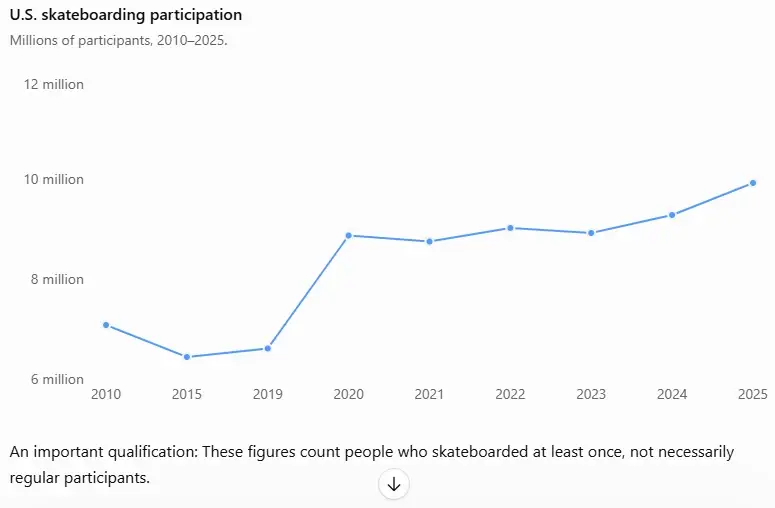
U.S. participation has moved up and down over time. The figures below count people age 6 or older who skateboarded at least once during the year, so they don’t measure how often participants rode.
Participation stood at 7.08 million in 2010 and 6.44 million in 2015. It reached 6.61 million in 2019, then rose to 8.87 million in 2020 and 8.75 million in 2021. The count was 9.02 million in 2022, 8.92 million in 2023, 9.28 million in 2024 and 9.92 million in 2025.
A historical estimate cited by the Smithsonian’s Lemelson Center puts skateboard sales at 50 million in 1965. That measure is different from participation: sales count boards, while participation counts people who rode at least once. There isn’t a dependable, publicly available national figure for how many Americans over 55, 65 or 75 skateboard, so overall participation numbers shouldn’t be read as evidence about older riders specifically.
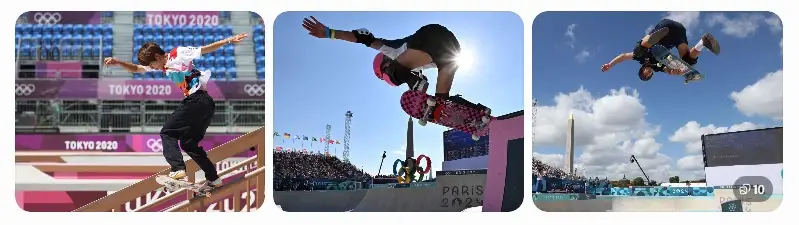
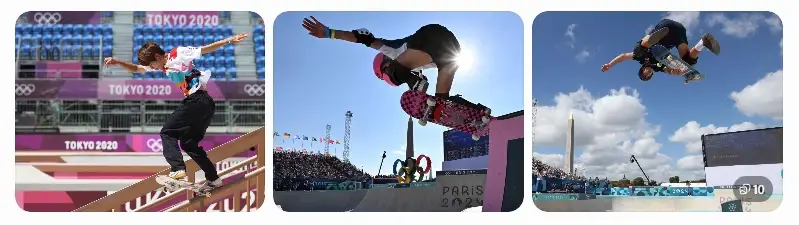
Skateboarding made its Olympic debut at Tokyo 2020, held in 2021. The program included men’s and women’s street and park events. Street competitions use features such as stairs, rails and ledges; park events take place in constructed bowls and ramps. The sport is scheduled to return at the 2028 Los Angeles Olympics, a setting close to its Southern California roots.
What could shape the next generation of skateboards
Electric boards have expanded skateboarding’s transportation possibilities by letting riders travel without pushing. Possible areas of development include longer battery life, lighter batteries, improved braking systems and lower-cost models. These changes could make powered boards more practical, though where they can be used will continue to depend on local conditions and restrictions.
Manufacturers are also experimenting with carbon fiber, fiberglass, composites and sustainable alternatives to maple. The aims include lighter, stronger and more durable boards, with less environmental impact. Sensors and smartphone applications could add another layer, tracking speed, balance, acceleration or technique and giving beginners feedback as they learn.
Access is another area to watch. Beginner-friendly skateparks could include smooth surfaces, seating, balance-training areas and instructors familiar with older learners. More inclusive designs could serve beginners, experienced riders, adaptive skateboarders and older adults. These ideas point to ways communities and recreational businesses could welcome more people without changing what makes riding appealing.
From wooden planks with roller-skate wheels to specialized boards and Olympic competition, skateboarding has adapted through small design improvements and new uses. Its next chapter may depend as much on welcoming more kinds of riders as on building faster or lighter equipment. For anyone curious about joining in, a steady first ride can be enough.


