
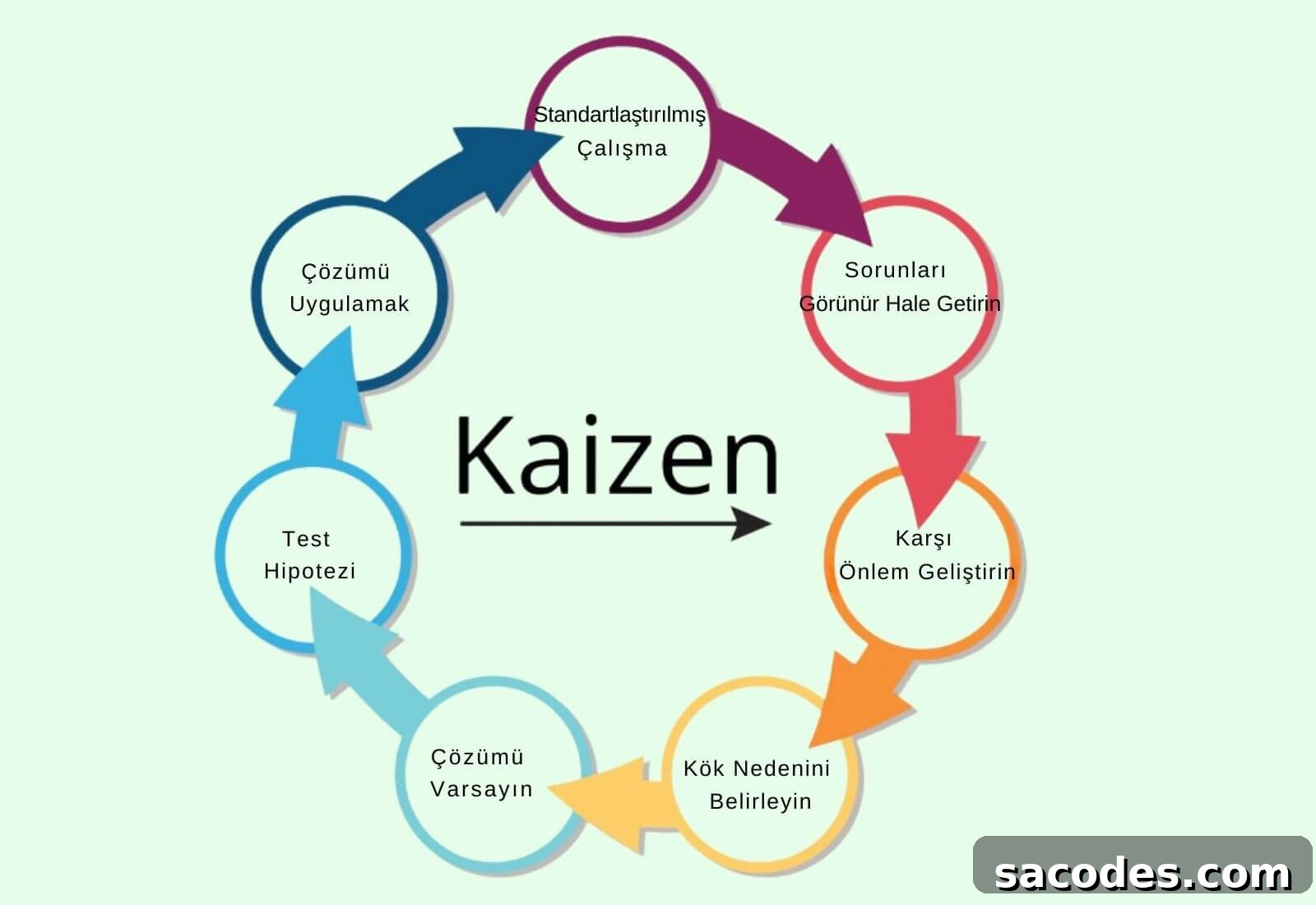
Kaizen is a Japanese management philosophy meaning “continuous improvement,” widely adopted in business to drive sustained progress through small, incremental changes. Originating in post‑World War II Japan and popularized by the Toyota Production System, Kaizen emphasizes practical, ongoing improvements in processes, teamwork and workplace culture to boost efficiency, quality and employee engagement.
Kaizen’s 10 Core Principles
1. Acknowledge and Identify Problems
One central Kaizen principle is to openly recognize problems rather than ignore or hide them. A culture of transparency and honesty enables an organization to discover root causes and treat each issue as an opportunity to improve. Encouraging teams to surface problems early prevents recurring defects and supports continuous learning.
2. Keep the Workplace Organized (5S)
Kaizen stresses workplace organization through the 5S methodology: Seiri (Sort), Seiton (Set in order), Seiso (Shine), Seiketsu (Standardize), and Shitsuke (Sustain). Implementing 5S reduces waste, improves safety, and makes processes easier to manage and improve.
3. Reduce Waste
Eliminating waste—whether of time, materials, or energy—is pivotal. Kaizen focuses on identifying and removing non‑value‑adding activities in workflows, streamlining processes, and optimizing resource use to lower costs and increase throughput.
4. Pursue Continuous Improvement
At its heart, Kaizen is about continuous, incremental progress. Small improvements made consistently compound into significant gains, enabling organizations to adapt quickly to market changes and maintain competitive advantage.
5. Foster Teamwork
Kaizen depends on collaboration. Teams are encouraged to work together to diagnose problems, propose solutions, and test changes. Inclusive participation accelerates idea generation and builds ownership of improvements across all levels.
6. Leadership and Support
Effective leadership is essential for Kaizen to succeed. Leaders must support improvement initiatives, provide resources, remove barriers, and inspire staff to engage in continuous development. Leadership commitment creates a safe environment for experimentation and learning.
7. Make Decisions Based on Data
Kaizen promotes fact‑based decision making. Using objective data and analysis reduces bias, clarifies performance gaps, and helps teams evaluate the real impact of improvements. Measurement and feedback loops are key to sustained progress.
8. Standardize Best Practices
When a better way is found, standardize it to ensure consistency and to prevent regression. Standardization preserves gains, makes training simpler, and provides a baseline for further improvement.
9. Engage Employees
Frontline employees often have the clearest view of process inefficiencies. Kaizen values their input and actively involves them in proposing and testing improvements. Participation increases morale and produces practical, implementable solutions.
10. Invest in Training and Development
Ongoing training builds the skills needed to identify problems, apply improvement tools, and sustain change. Continuous learning strengthens organizational capability and ensures improvements are embedded long term.
Benefits of Kaizen
Adopting Kaizen produces measurable business benefits and healthier workplace dynamics. The approach combines process optimization, cultural change and employee engagement to deliver improved performance across operations, quality and customer satisfaction.
- Increased Productivity: Continuous elimination of unnecessary steps and improved workflows accelerate throughput and reduce cycle times.
- Lower Costs: Reducing waste and improving resource utilization decreases material and operational expenses, improving profit margins.
- Higher Quality: Ongoing refinement of processes and standardization lead to fewer defects and more consistent products or services.
- Improved Employee Morale: Involving staff in improvement work gives them ownership and recognition, boosting engagement and retention.
- Stronger Collaboration: Kaizen fosters cross‑functional teamwork, combining diverse perspectives to create practical innovations.
- Greater Customer Satisfaction: Better quality and faster response improve customer experiences and loyalty.
- Enhanced Agility: A culture of continuous improvement helps organizations adapt quickly to changing market demands and seize new opportunities.
- Safer Workplaces: Organized, standardized processes reduce hazards and contribute to fewer workplace accidents.
- Reinforced Corporate Culture: Shared improvement routines and values strengthen corporate identity and long‑term alignment across teams.
- Sustainable Long‑Term Gains: Small, steady improvements compound over time to deliver lasting competitive advantages and sustainable growth.
Kaizen is more than a set of tools—it’s a mindset that drives durable change. By embracing principles such as problem recognition, waste reduction, 5S organization, data‑driven decisions, standardization, employee involvement and continuous learning, organizations can build resilient processes, higher quality outputs and a culture committed to ongoing improvement.