
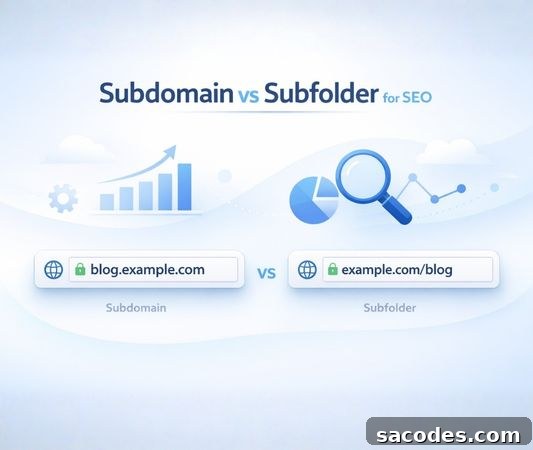
Technical architecture decisions in web projects are often invisible, but they directly affect search engine performance. One fundamental structural choice—whether to use a subdomain or a subfolder—impacts organic visibility, indexing speed, and how authority is distributed across your site. In this article, we analyze in detail which option is more advantageous for SEO, covering everything from technical infrastructure to search signal implications.
What Is a Subdomain? Technical and Structural Characteristics
Subdomain is an additional domain prefix attached to the main domain, such as blog.example.com or support.example.com. Technically, a subdomain is a separate DNS record and can point to an independent server or environment.
This structure is often chosen when different systems need to be integrated. For instance, the main site might run on one platform while the blog runs on another CMS, allowing development and deployment processes to remain isolated. Security layers and access controls can also be configured independently for each subdomain.
However, there is an important SEO consideration: search engines often treat subdomains as separate properties from the main domain. That means domain authority may not automatically be shared, and each subdomain may need its own link-building and optimization effort.
What Is a Subfolder? The Power of URL Hierarchy
Subfolder refers to directories under the main domain, for example example.com/blog or example.com/services. Technically, subfolders operate under the same domain and usually the same server.
With this approach, all content is consolidated under a single domain, which helps search engines perceive the site as a cohesive entity. For content-driven projects, the SEO advantages of subfolders become evident because accumulated authority pools into one central resource.
Internal linking strategies are typically more efficient with subfolders: links from the homepage or other pages pass authority directly to nested content. This consolidation can speed up indexing and increase ranking potential.
Key SEO Differences Between Subdomains and Subfolders
→ Authority Distribution and Backlink Impact
One of SEO’s most critical factors is domain authority. The question of “subdomain vs subfolder for SEO” often comes down to how authority and backlinks are distributed across your property.
Backlinks to pages in a subfolder contribute directly to the main domain’s strength, allowing all pages to benefit from a shared authority pool. In contrast, subdomains can be evaluated separately, so you may need distinct link-building strategies for each subdomain. For new projects, subfolders often yield faster ranking benefits because authority is consolidated more quickly.
→ Crawl Budget and Indexing
Search engines allocate a crawl budget to each site, and crawl efficiency becomes important for large-scale projects. With subfolders, bots usually treat the site as a single entity, making crawling and indexing more consolidated. Subdomains, however, can be perceived as separate sites, which can lead to slower indexing—especially if the domain has low authority.
→ Keyword Strategy and Topical Authority
For topic clustering and semantic structure, subfolders create stronger relationships between categories and supporting content. For example, example.com/seo/technical-seo clearly signals the connection between the category and its articles.
A structure like blog.example.com/seo may form a weaker semantic link to the main domain in practice. While search engines can understand the relationship, building topical authority is usually faster and more straightforward within subfolders.
When to Choose a Subdomain
Although subfolders are often favored for SEO, there are situations where a subdomain is the more logical technical choice.
Consider a subdomain when:
-
Different languages or country sites are managed by separate teams
-
A SaaS dashboard or user login area must be isolated from the main site
-
The technical stack will be hosted on a completely different server or infrastructure
-
Corporate structure requires department-level, independent content management
Support platforms and community forums are frequently placed on subdomains for scalability and operational reasons rather than SEO advantage.
When Subfolders Are More Advantageous
Subfolders tend to be the better option for content marketing, blog management, and category-based service pages. The SEO benefits of subfolders are especially clear when the goal is to centralize authority and make internal linking robust.
Prefer subfolders if:
-
Blog content directly supports your core services
-
You want to grow backlink equity centrally
-
You aim to build a strong digital presence under a single brand
-
You have a small technical team and want simple management
This setup simplifies both user experience and the search engine signals your site emits.
Real-World Analysis: How Major Sites Choose
Large-scale analyses show that most content-focused platforms place their blog under a subfolder. The reasons extend beyond SEO: data integrity, easier analytics tracking, and consistent brand perception also play a role.
Some technology firms, however, publish product documentation on subdomains—usually to separate software versions or to manage documentation independently from the marketing site.
There is no single correct answer, but if SEO performance is the priority, subfolders are often the more advantageous choice.
Technical Risks and Considerations
Choosing based solely on SEO signals is not enough. Server configuration, CDN integration, security policies, and redirect strategies must also be considered.
For example, a misconfigured subdomain can cause canonical issues, while overly complex URL structures within subfolders can create indexing problems. Therefore, conduct a technical SEO audit before making an architectural decision.
If you plan to migrate from a subdomain to a subfolder (or vice versa), carefully plan 301 redirects to avoid losing organic traffic.
Strategic Choice: SEO Goals or Operational Flexibility?
Ultimately, the decision between subdomain and subfolder is strategic. If the primary goal is to build strong domain authority and extract maximum SEO value from content, subfolders usually perform better.
If operational isolation, different software stacks, or independent management are required, subdomains can be the right solution. The key is to align the structure with your long-term growth plan.
In many SEO projects, teams prefer subfolders in the early years to consolidate authority quickly. As the organization scales, hybrid approaches can be adopted thoughtfully.
A well-designed architecture influences not only search rankings but also user experience and conversion rates. For that reason, technical SEO specialists and development teams should collaborate when choosing the best structure for your site.