Shopping
Their Hobbies: What U.S. shoppers Pay
Sure, you may have picked up an extra hobby or two during your added time indoors, but did you know that hobbies were peaking in the U.S. as early as 2016? And the trend has only

But there’s so much more to the story. We’ve recently compiled millions of data points from reputable sources like the U.S. Census Bureau, Statista’s Global Consumer Survey, Microsoft Advertising, and others to see what American spending on hobbies really looks like. What are people taking an interest in? How much are they spending? How are the industries involved in each hobby responding? Keep reading to learn.
Hobby Trends in the U.S.
The study kicks off with a look into hobby data from both the U.S. Census Bureau along with Statista’s Global Consumer Survey. Their data was compiled and analyzed to reveal the total monthly retail sales of hobby, toy, and game stores in the U.S. up through January of 2021 and the overall most popular hobbies in the country at present.
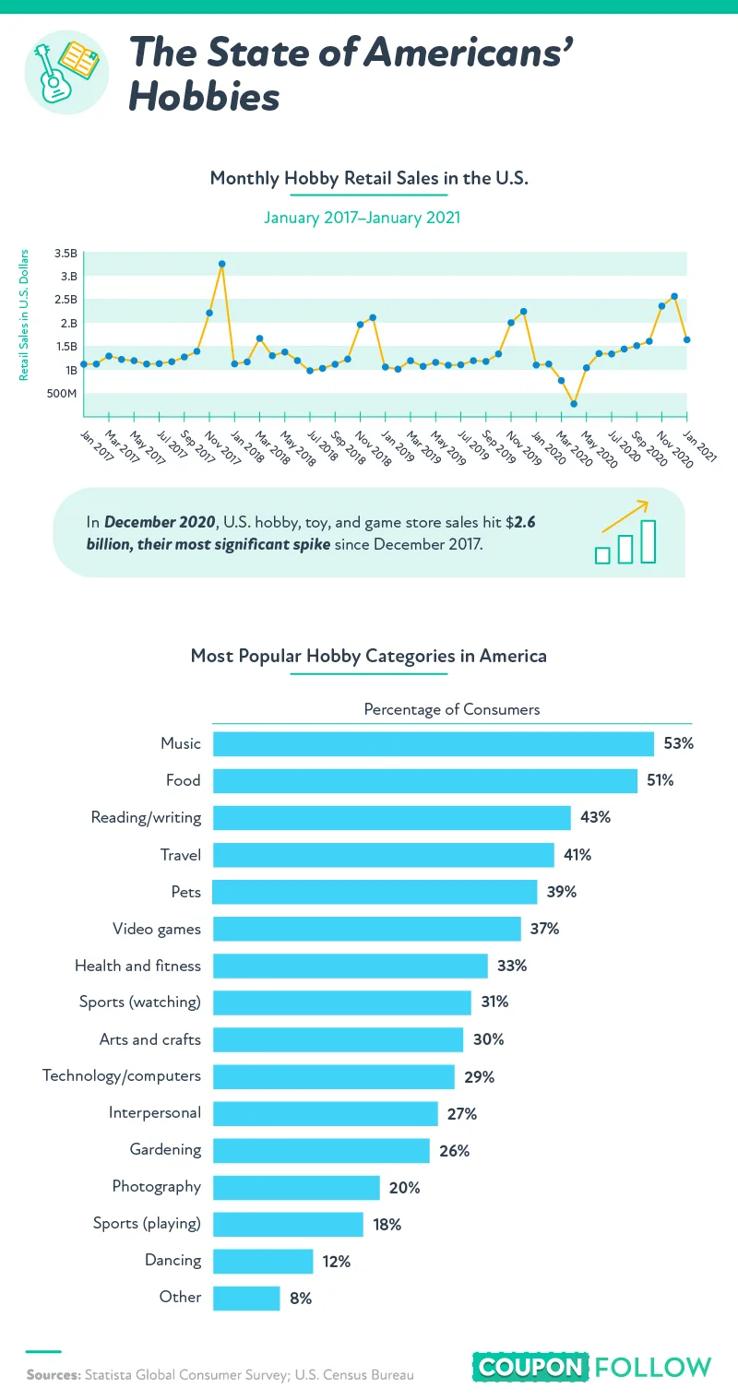
Music is currently the most popular hobby in 2021. This and food are the only two hobbies in which the majority of U.S. shoppers participate. While music can be free and low-priced on the listener’s side of things, instruments and equipment for those who decide to play may accrue a different cost. Food costs the average American individual roughly $2,641 annually, and this figure likely increases if it’s your primary hobby. Many U.S. shoppers leaned into things like reading and writing (43%) or health and fitness (33%) as well.
Contrary to what many would assume, the pandemic didn’t consistently correlate with a spike in hobbies. Actually, March of 2020– which was the month the NBA decided to cancel their season —saw the lowest monthly retail spending on hobbies and toys in the last four years. In many homes, this time was surrounded by confusion and panic, both financial and otherwise. This uncertainty impacted American consumer spending to drop by 7.5%, as we’re seeing reflected in hobby spending. Nevertheless, as the pandemic wore on and it became clearer that we may be spending more time indoors than we’d hoped, hobbies saw an incredible spending rebound. By December of 2020, U.S. hobby, toy, and game store sales totaled $2.6 billion, the most significant spike since the end of 2017.
Top Sellers of Hobby Gear
Next, our study focuses on the individual retailers who reaped most of the rewards behind this newfound hobby interest. We also took a peek into which states saw the biggest surges and declines in retail sales of hobby-related goods.
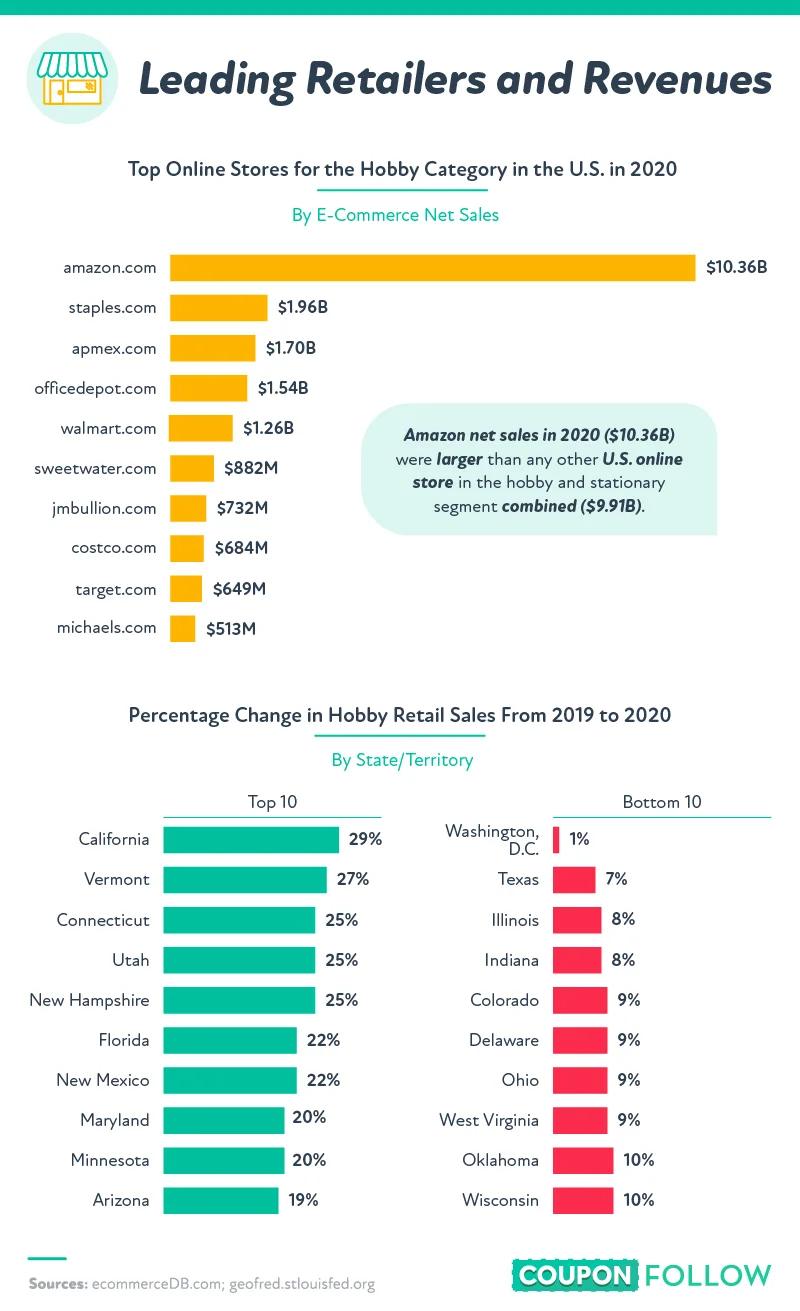
Amazon eclipsed all other retailers for hobby sales—even the big players like Walmart and Staples couldn’t compete. Where Amazon saw $10.36 billion in sales, Walmart saw just $1.26 billion. Actually, Amazon’s sales amounted to more than the other top hobby and stationery segment stores combined.
California saw the biggest increase in hobby-related spending out of any state. California also happens to have the highest consumer spending economy of any state, so getting this number to increase by the largest percentage was no easy feat. Vermont came in a close second, with a 27% increase in hobby-related spending.
The Pandemic’s Influence
While the U.S. Census Bureau previously offered us insight into monthly sales, the entire story of the pandemic’s impact on hobbies wasn’t encapsulated this way. Here, we turned to data from Microsoft Advertising to see which particular online retail categories surged the most pre- and post-COVID-19.
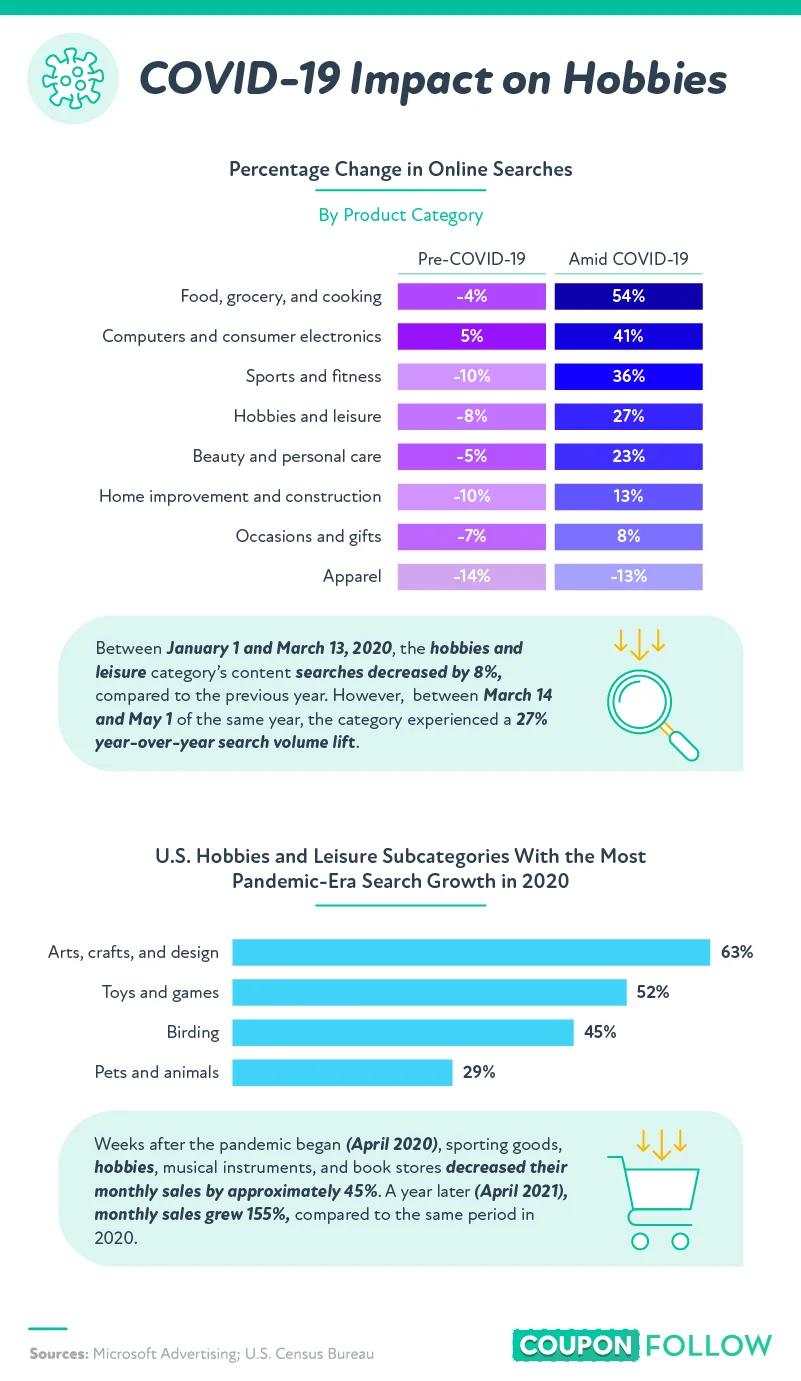
When the world first adjusted to the pandemic between January and March of 2020, the hobbies and leisure category’s content searches decreased by 8%. However, between March and May of the same year, the category experienced a 27% year-over-year search volume lift. Similarly, in the weeks immediately following the pandemic (April 2020), hobby stores decreased their monthly sales by about 45%. But just a year later (April 2021), monthly sales grew 155% compared to the same period in 2020. In other words, the pandemic caused an enormous halt in hobbies followed by an enormous upswing.
The apparel industry took the largest hit in the initial stages of the pandemic. Without the ability to go to events, work, or even church, the necessities of the modern wardrobe really changed and didn’t require much spending. Similarly, occasions and gifts saw an enormous dip without the occasions with which to spend. Even home improvement—which we now see taking the world by storm—saw a 10% dip in interest with the shock of the initial pandemic.
The most successful post-pandemic rebound were arts, crafts, and design as a hobby. Mental health experts actually insist that arts and crafts are a particularly therapeutic way for many to cope during the pandemic. A craft like knitting, for instance, has been proven to increase feelings of calm and happiness. Depending on the craft, it can also be a particularly low-priced hobby.
Hobbies for Life
With so many U.S. shoppers dipping their toes into the wonderful world of hobbies recently, many have likely picked up lifelong practices of enjoyment and entertainment. Even with the intense life changes in the beginning of the pandemic, its ultimate impact was one of invigoration in the hobby industry. Every interest from cooking to music and home improvement saw enormous influxes of new participants. And naturally, all of this had America spending.
If a particular hobby feels exclusive simply because of the cost to try it, know that you have choices. Actually, Sacodes offers serious discounts 24/7 from all of the retailers you love the most. Whether pets, fashion, or health is your thing, Sacodes can help you get started for much less money. Then you can get down to enjoying what the hobby is really about. Head to Sacodes.com today to see how we can help you save!
Methodology
For this project, we used statistics from different sources to explore the state of U.S. shoppers’ hobbies in 2020. We analyzed retail sales data, consumer behavior and preferences data, and online retail searches. When referring to hobbies in our study, we included sporting goods, musical instruments, books, toys, and games. We used the following sources in our study:
- Statista Global Consumer Survey:
- Hobbies & interests in the U.S. 2021
- U.S. Census Bureau:
- Hobby monthly retail sales in the U.S.
- U.S. year over year monthly retail sales comparison
- eCommerceDB
- Top online stores for the hobby category in the U.S.
- GeoFRED:
- Percentage change in hobby retail sales from 2019 to 2020, by state
- Microsoft Advertising:
- U.S. Hobbies and leisure subcategories with the most pandemic-era search growth in 2020
- Percentage change in online searches, by item category
Topics Gifts