Shopping
Coupon Usage & Shopping Behavior Trends [REPORT] (2021)
Among the trends to emerge out of the last 12 months marred by the global pandemic is the meteoric rise of e-commerce and online shopping. Per some estimates, U.S. shoppers spent
![Coupon Usage & Shopping Behavior Trends [REPORT] (2021)](/assets/media/coupon-usage-trends-6f52a19d.jpg)
Along with the growth in online shopping spend came the increased use of digital discounts and promotional codes. As America gradually emerges out of the pandemic, are the shopping patterns of the last 12 months here to stay? We surveyed more than 1,300 adults in the U.S. to identify key shopping trends and drivers, explore the use of coupons, and understand the role of digital discounts in how U.S. shoppers shop online in 2021.
Our own research suggests that digital coupons are more key than ever with as many as 96% stating they search for a discount code before making a purchase online.
Key Findings
- Online Shopping is Increasingly Mobile
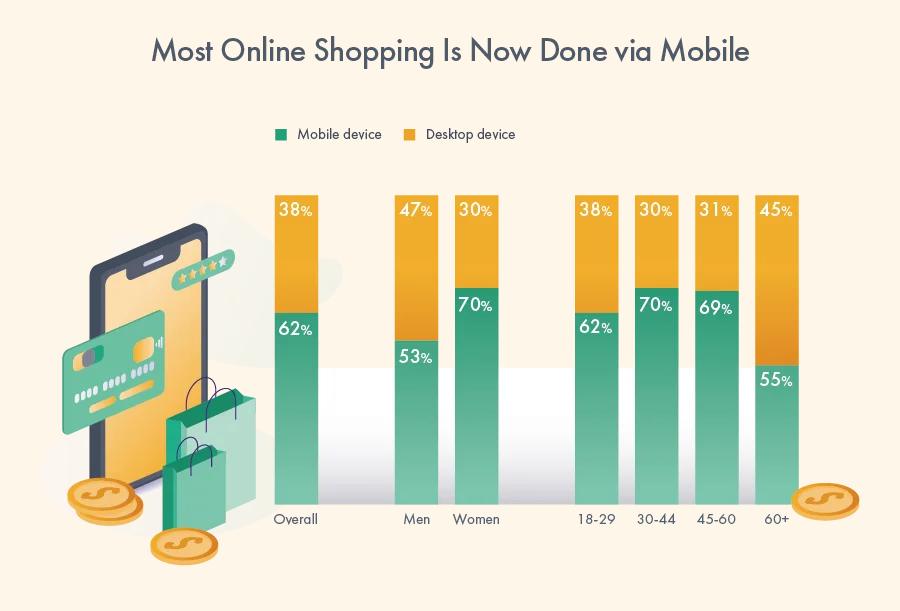
Regarding shopping online, 62% of U.S. shoppers stated they make the majority of online orders on their phone. This includes 70% of women and 70% of those aged 18 to 29. Only 38% of U.S. shoppers stated applying a laptop or desktop computer to make online orders.
- Almost Everyone Tries To Find a Discount
Nine in ten (96%) U.S. shoppers stated they search for a discount code or a digital coupon before making an online purchase, with only 4% stating they never do. Furthermore, 83% have used a digital discount code at least once when shopping online and about three in four (73%) reported they love receiving digital coupons.
- Discounts Can Boost Brand Loyalty
Around 73% admit that receiving discounts from brands makes them more loyal shoppers,two-thirds (66%) discover brands through discount codes, and equally as many (66%) state they’d be more likely to visit a store in-person if they had a coupon to redeem there.
- The Price Has to Be Right
Price is the most significant buying factor, with 84% reporting it’s part of their consideration and 61% saying it’s the single most key factor for them. Two-thirds (66%) of U.S. shoppers became more price-conscious in the last 12 months.
- U.S. shoppers Love Discounts on Fashion and Food Delivery
Clothing (59%), takeout (42%), and beauty/self-care (37%) were the top shopping categories for U.S. shoppers that shop with coupons and discount codes. Meal delivery and pet supplies were tied for the fifth most common purchase type for discount code users (32%).
On Mobile, But Not Without Struggles: How U.S. shoppers Shop Online in 2021
Almost two-thirds (62%) of U.S. shoppers we surveyed report making the majority of their online orders applying a mobile device rather than a desktop or laptop computer.
Women were more likely to use their phones to shop than men (70% vs. 53%), as those aged 30-44 were more actively shopping on their mobile devices (70%) than those over 60 years old (45%).
Pain Points When Shopping on Mobile
Shopping on mobile, while convenient, has its pitfalls and consumers struggle in certain areas when browsing on e-commerce websites. Below we’ve captured some of the significant issues reported when shopping online.
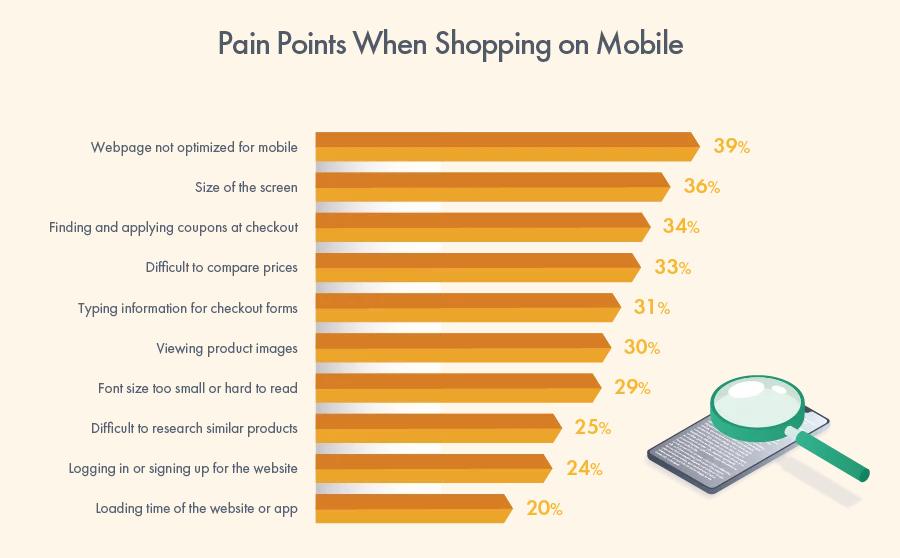
Websites not being optimized for a mobile device was the most common pain point for American consumers shopping on their mobile devices (39%).
Accessibility can be a big issue for e-commerce, and about 1 in 3 (38%) of older U.S. shoppers (over age 60) shopping on their phones and tablets found font sizes too small or hard to read. This was also reported by about 1 in 5 (20%) of young U.S. shoppers aged 18-29.
Checkout-related pain points like finding and applying coupons at checkout (34%) and typing details for checkout forms (31%) were among the most common issues reported. Younger people (aged 18-29) had the most trouble applying coupons at checkout (38%). More than a third (37%) of older U.S. shoppers (aged over 60) struggle with typing details for checkout forms on mobile.
Around 30% of shoppers had issues viewing item images and having to zoom in to click the right thing - both of which are areas for improvement for brand and retailer websites likely looking to capitalize on their e-commerce boom of the last 12 months.
All About That Price: The Key Buying Factor In Online Shopping
Per our research, item price is by far the most key factor in shopping. As many as 84% admitted it impacted their buying decisions, while 61% acknowledged that it’s the single most key factor driving their buying decisions.
Price is the most influential shopping factor across demographics, being most commonly mentioned by those aged 45-60 (87%) and least by those over 60 years old (81%).
Curiously enough, price had a stronger influence among the most high-earning respondents in our research, as 85% of those earning $100k a year or more reported their behavior is mostly influenced by price—more than any other income bracket.
Among the side effects of living in a global pandemic for the past 12 months may be that U.S. shoppers have become increasingly price-conscious.
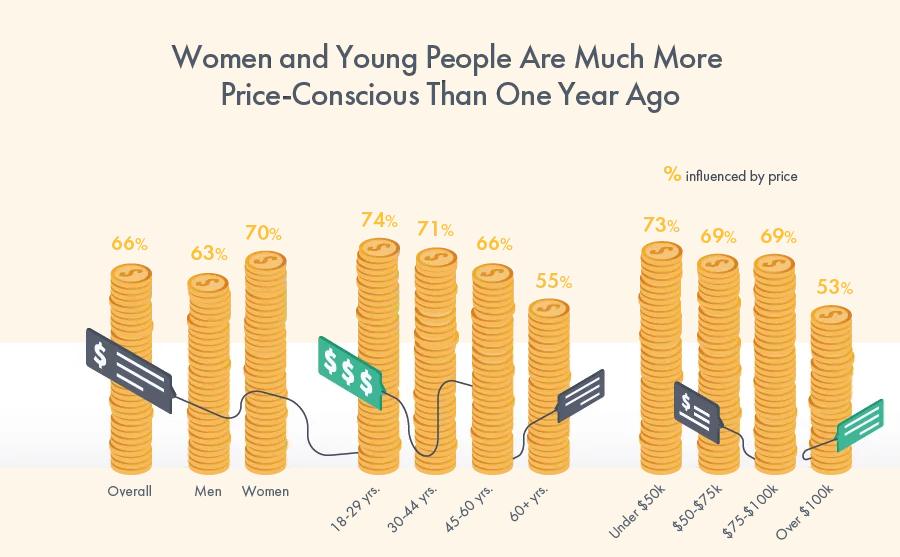
Two-thirds (66%) of U.S. shoppers admitted to being more price-conscious than they were a year ago. Nearly three-in-four (74%) young U.S. shoppers (aged 18-29) became more price-sensitive in the past 12 months, compared to 55% of those over 60 years old.
Furthermore, women (70%) were more likely than men (63%) to adopt a price-sensitive approach to their shopping. Three quarters (73%) of those with incomes under $50k a year became more price-conscious in the 12 months of the COVID-19 pandemic, in contrast with those earning over $100k, of whom only half became more aware of price when shopping online.
Shipping, Ratings, and Brand: Key Drivers Behind Buying Decisions
Second only to price in its influence, shipping time was the next most key factor in online shopping, as noted by more than half (53%) of respondents in our research. Shipping time was of greater importance to young people, as 59% of those aged 18-29 mentioned it, compared to only 45% of those over 60 years old.
Vital as it may be as among the factors, only 11% of U.S. shoppers said shipping time was the most key driver of their buying decisions when shopping online.
Ratings came out third in our ranking of factors affecting online shopping, with a slight majority of 51% of respondents in our survey mentioning it. Much like with shipping time, it was marginally more key to the younger age group aged 18-29 (56%) than their older counterparts aged over 60 (49%).
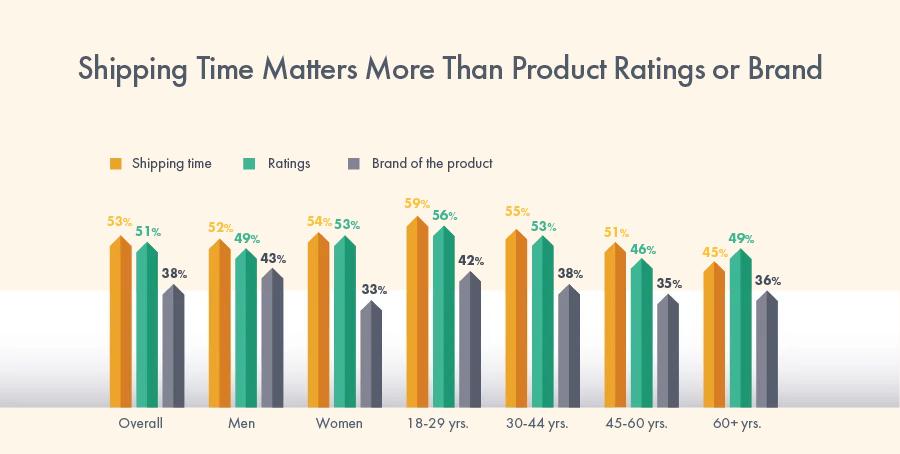
As much as U.S. shoppers like certain brands and have their favorites across categories, brand as a factor doesn’t have much pull among our study participants. Only 38% of respondents said it affects their shopping decisions, and just 8% noted it was the key factor for them.
Perhaps predictably, brand as a factor had a stronger effect on those aged 18 to 29 (42%) than those over 60 (36%). However, what is rather surprising is that those on higher incomes were up to 60% more likely to factor the brand into their shopping decisions (61% for those earning $75k-$100k vs. 38% among the general population).
Savings Savvy: U.S. shoppers’ Enduring Passion For Discounts
Who doesn’t love a discount, especially if you can get it as easily as entering a discount code at checkout? An overwhelming majority of U.S. shoppers certainly do, as per our study a whopping 96% search for a discount code or a coupon before making an online purchase with only 4% stating they never do. Over half (51%) stated they frequently (always or often) search for a discount code before making a purchase.
Women were more likely to have searched than men (87% vs. 78%), and over two-thirds (69%) of people over age 60 search for discount codes online.
And it’s not just the digital coupons U.S. shoppers are after. More than half (58%) used a physical coupon at least once when shopping. People aged 30-44 were most likely to use a physical coupon (63%) than any other age group, and those over 60 years old were least likely (49%).
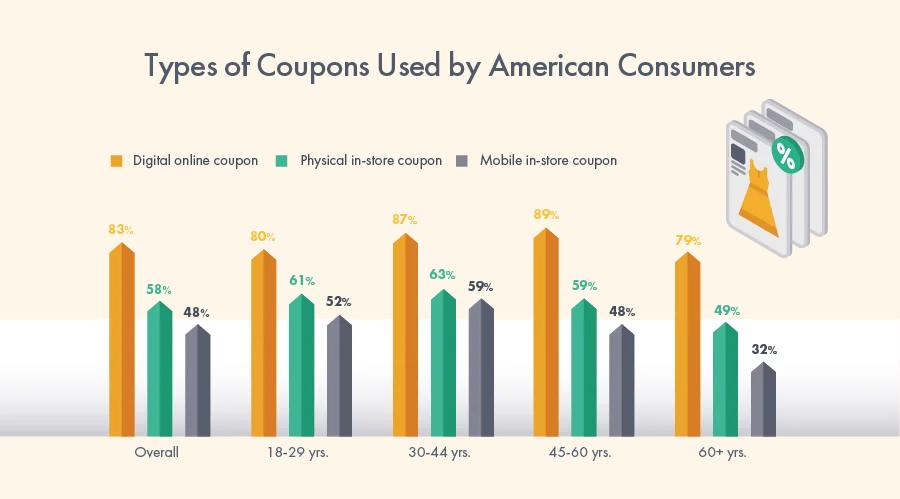
Almost every other American (49%) has used a mobile in-store coupon, e.g., on their phone or via a QR code, with 30-44 year-olds applying mobile coupons (59%) almost at the same rate as physical ones (63%).
Discount Preferences
Discounts in the form of dollars off or percent off were of the most interest (44%) while Shipping at no charge was the most preferred form of a discount to about one in three (30%). However, in the 60+ age group, Shipping at no charge was the most preferred at 42% compared to 32% stating dollar or percent off discounts were preferred. Younger U.S. shoppers (18-29 year-olds) were the least interested age group in Shipping at no charge as a discount.
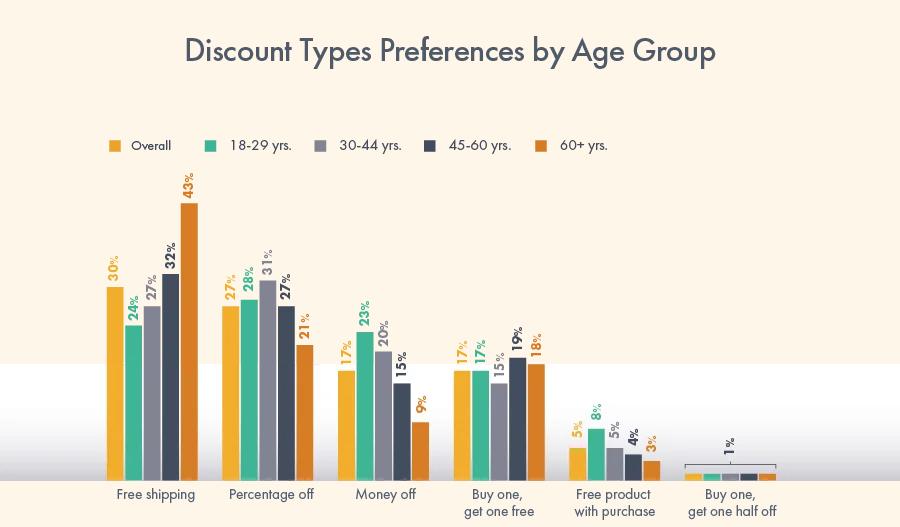
While seeing a dollar off amount may be easier to understand, U.S. shoppers were reporting that a percentage off their purchase is what they prefer. Percentage-based discounts had their peak appeal among 30-44 year-olds with 31% of that age group preferring them compared to 20% stating dollar off coupons were preferred.
Are Coupons Worth The Effort?
We all know that finding a discount code can take some time, but how much? In our study, we found that, on average, U.S. shoppers spend 4 minutes looking for a discount code when making a purchase, with 59% spending between 1 and 5 minutes looking for coupons before checkout.
What are they called anyway?
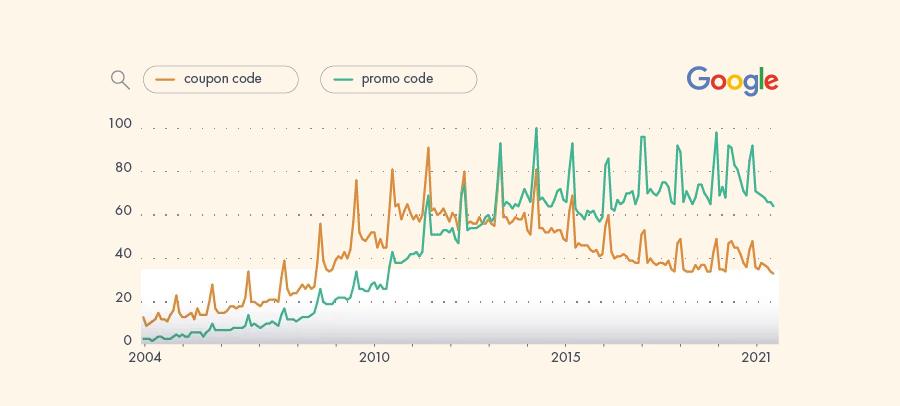
When you enter a code at checkout, what do you call it? While major e-commerce platform Shopify refers to them as discount codes, most U.S. shoppers over the last two decades have shifted from calling them coupon codes to discount codes. In our study 44% referred to them as discount codes, followed by 28% calling them discount codes and 17% calling them coupon codes.
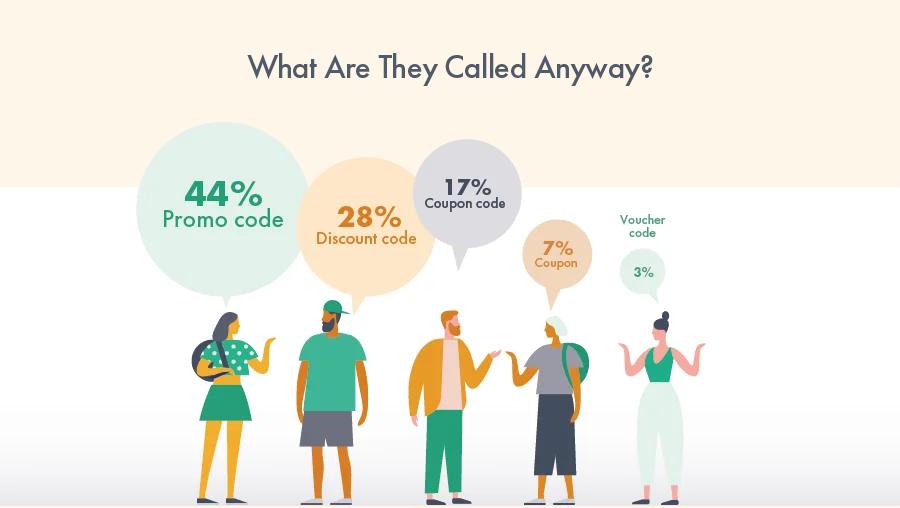
Fun fact: Per Google Trends the term coupon code was more popular in the early days of e-commerce until about 2013 when the term discount code overtook it.
More Than a Discount: The Hidden Power of a Discount code
Discounts and discount codes can have a powerful influence on the modern consumer from brand perception to purchase decision making.
Three-quarters of U.S. shoppers love receiving coupons (74%), which includes 79% of women and 68% of men. Those aged 18-29 have the highest appreciation of discount codes (83%), compared to 57% of those over 60 years old.
Moreover, coupons offered by brands make almost every three in four (73%) U.S. shoppers feel more loyal as shoppers. This is more the case with women (77%) than with men (69%), and more the case with young people (84% of 18-29) than older U.S. shoppers (53% of those over age 60).
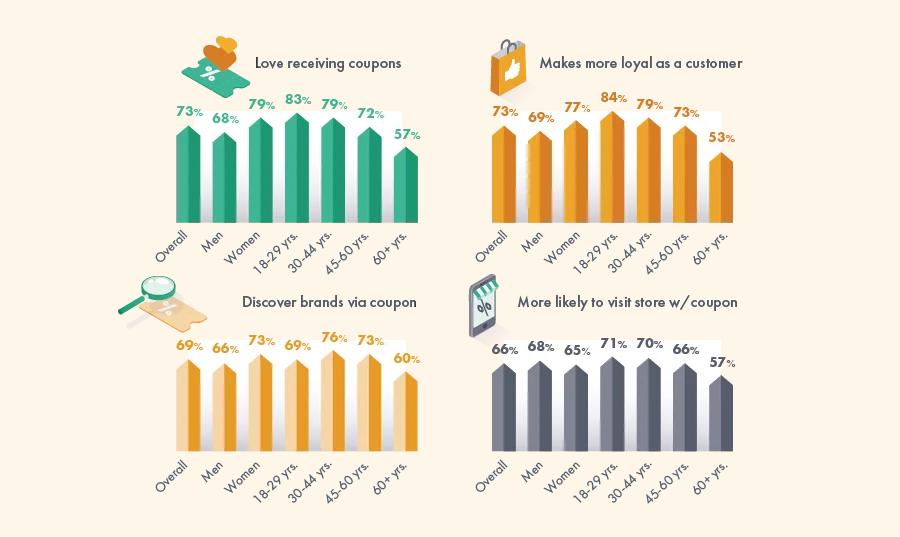
Also, as many as two-thirds (66%) of our study participants claim to discover new brands through coupons. This has been reported by 76% of those aged 30-44, more than in any other age group.
As many as 82% of our study participants said they’d be more likely to try a new item/brand with a coupon, which includes 87% of women and 78% of men.
Higher earners, those earning $75k a year or more, were more likely to discover new brands with the help of a discount code than those on lower incomes.
Discount consideration is a key part of the purchase decision process. More than half (58%) of respondents in our survey say discounts or promotional offers are very key when deciding whether to purchase from a retailer or brand.
Discount Delivery Trends In 2021: Email vs. Texts vs. Snail Mail
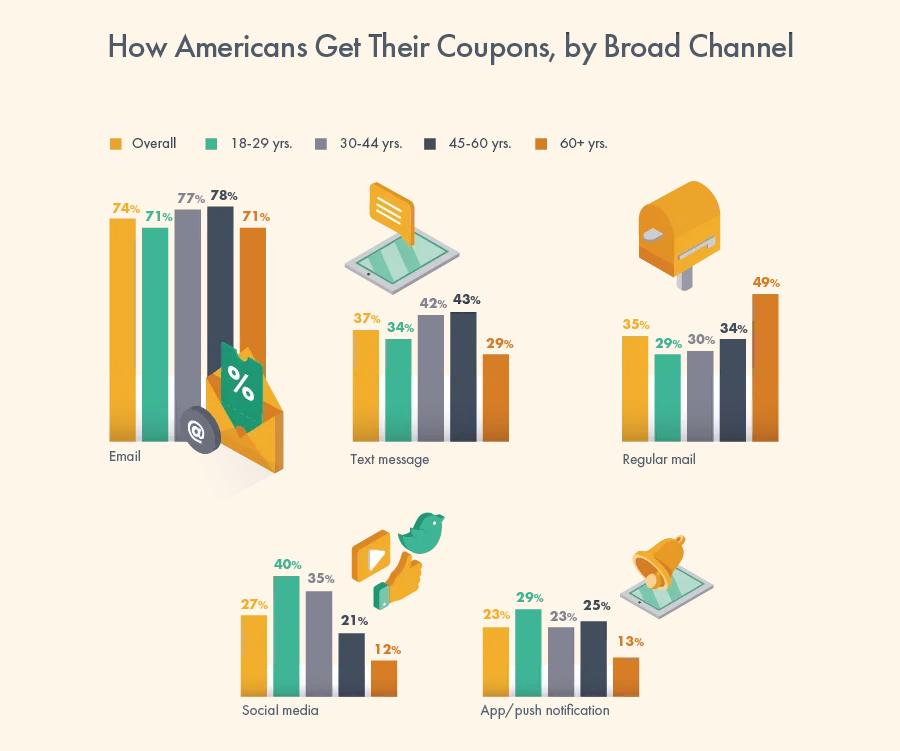
U.S. shoppers tend to get their coupons mainly via email (74%) and, as befits a nation that prefers to shop on their mobile device, via text message (37%).
People aged 45-60 were most likely to get coupons via text (43%) compared to 42% of 30-44 year-olds and 34% of 18-29 year-olds.
Surprisingly enough, the good old snail mail is the third most common way of getting coupons (35%) in 2021, ahead of social media (27%) and apps/notifications (23%). Somewhat expectedly, almost half (49%) of those over 60 years of age receive their coupons by regular mail, more than any other age group.
Those aged 18 to 29, then again, were more likely to get their digital discounts from dedicated coupon sites (33%), while nearly a third (29%) get their discount codes from apps and push notifications.
About one-third (34%) get coupons that are included in packages from previous orders (33%).
It’s the members of the older age group (over age 60) who were more likely to get coupons from previous orders (38%), compared to people between 18 and 29 years old (26%).
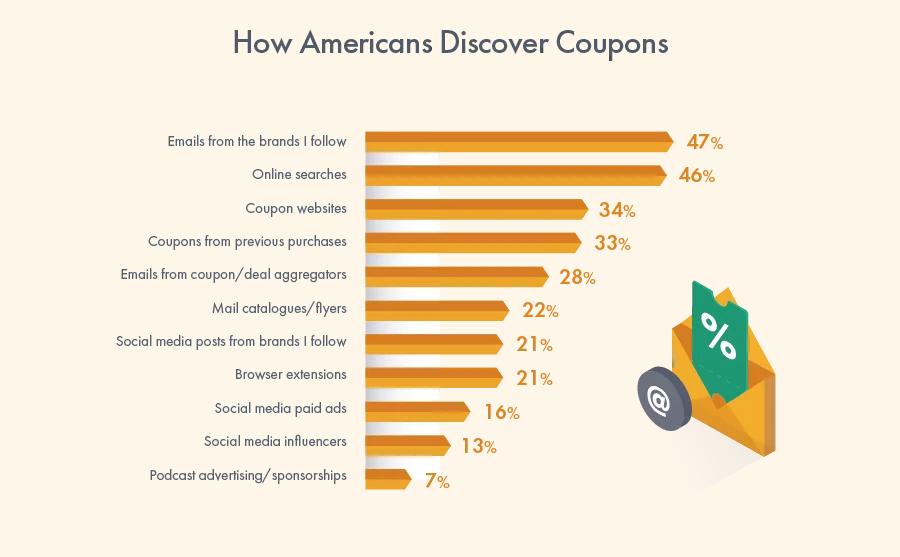
The least common ways of discovering discount codes were social media paid ads (16%), social media influencers (13%), and podcast advertising/sponsorships (7%). That said, about one in ten (10%) men said they find discount codes on podcasts they listen to.
Shopping For Deals On Social: Facebook Dominates Landscape
In recent years Influencers on social media have begun working closer with brands, and brands themselves have utilized social platforms directly, to offer special promotions. Favored by close to half (42%), our research shows Facebook is the most common social media for U.S. shoppers looking for discounts and deals online. The tech giant’s other property - Instagram - is also a preferred social media for 30% of bargain hunters.
Most notably, it was those over age 60 taking to Facebook in pursuit of discounts (38%), while nearly half (47%) those aged 18 to 29 preferred Instagram.
The younger age group prefers Instagram (47%) compared to older age groups which prefer Facebook primarily for finding discounts.
For a quarter of shoppers (25%), YouTube was where they found their deals. The world’s biggest video streaming site was most popular with the young people aged 18-29 (36%) for finding discounts.
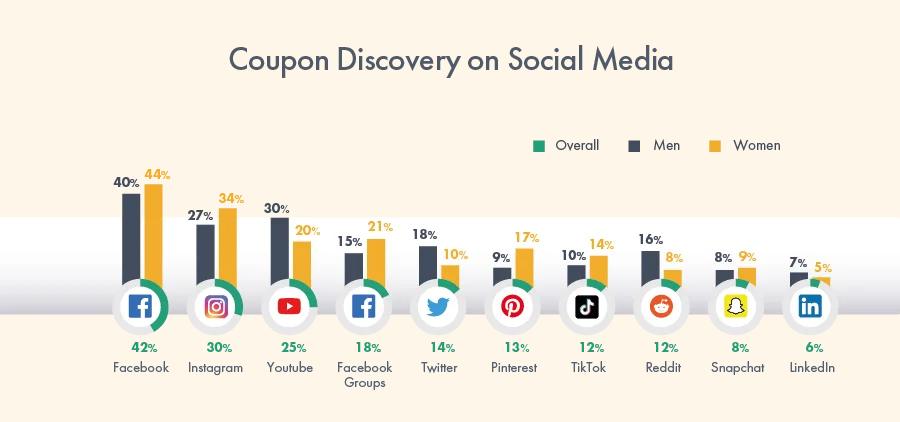
The breakout star of social media in 2020 was naturally TikTok, in which our research suggests it was used by one in five (22%) of 18-29-year-olds to discover discounts for their orders. Only 13% of 30-44-year-olds reported applying the service to find discounts, and only 1% of those over 60.
Sites like Reddit and Pinterest garnered 12% and 13%, respectively, as destinations for digital discounts. Snapchat and LinkedIn were only mentioned by 8% and 6% of our study participants as sites they use to discover coupons and deals.
There were a few notable differences between men and women regarding finding digital discounts on social media. Men were more likely than women to find deals on YouTube (30% vs. 20% of women), Reddit (16% vs. 8% of women), and Twitter (18% vs. 10% of women).
Conversely, women were more likely to use all other social media, but most notably Instagram (34% vs. 27% of men) and Pinterest (17% vs. 9% of men).
Spending Patterns Of Discount Shoppers
Clothing (59%), takeout meals (42%), and beauty/self-care (37%) were the most commonly purchased items among U.S. shoppers shopping with coupons and discount codes.
Men were less likely to shop for clothing with a discount code (51%) than women (67%). Then again, women were 2.5 times more likely to use a coupon while shopping for beauty items than men (52% vs. 20%).
Pet supplies were the fifth most common purchase for discount code users (32%). Again, female shoppers were more likely to purchase these items than their male counterparts (39% vs.24%).
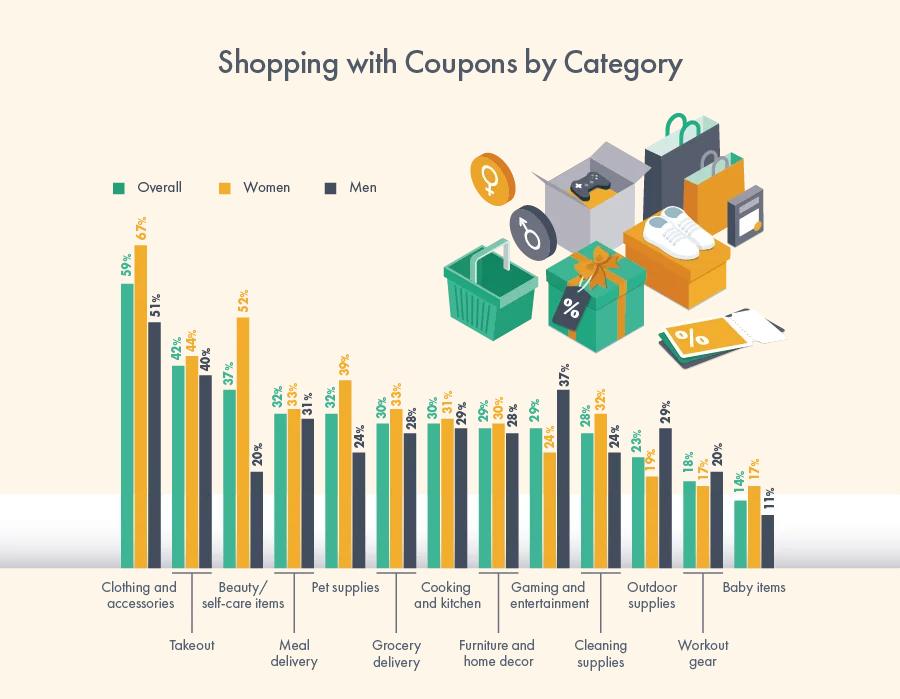
In turn, men were more likely to use a discount code when shopping for gaming/entertainment (37% vs. 24% of women), outdoor supplies (29% vs. 19% for women), and workout gear (20% vs. 17% of women). In our study, baby items were the least most common shopping category for discount code users - just 14% of U.S. shoppers purchased baby items and used a coupon.
Looking at different age groupings, young people (18-29 year-olds) were significantly more likely than older U.S. shoppers (aged over 60) to make a purchase with a discount code when shopping for gaming (24% vs. 7%) and workout gear (40% vs. 10%).
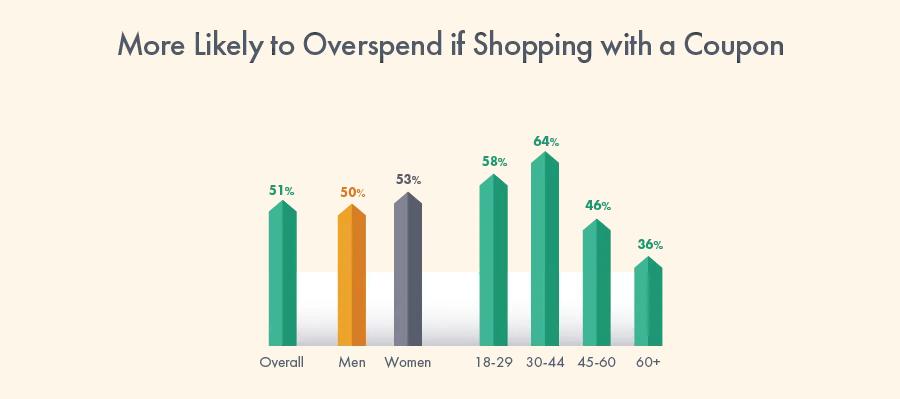
More than half (51%) typically wind up spending more when shopping with a coupon that requires a minimum spend. U.S. shoppers over age 60 are most resistant to overspending (36%), while 30-44 year-olds are most prone to it (64%).
On average, U.S. shoppers reported they spend $23 more when applying a coupon, with men tending to spend $25 more compared to women’s $22. Young people aged 18-29 spend twice as much as those aged over 60 ($28 to $14).
Research Summary
In the wake of the COVID-19 pandemic, U.S. shoppers remain extremely price-conscious when shopping online. This is likely why digital discount and coupon use is near-ubiquitous in online shopping, as the overwhelming majority of U.S. shoppers make it a part of their checkout journey and purchase consideration.
Our research has shown that discount codes and coupons are much more than just a means to save. They can aid brand discovery, boost shopper loyalty, encourage visits to online and physical stores, and increase cart value for e-commerce vendors. As e-commerce became an even more essential part of the American online shopping experience in 2020 and 2021, digital discounts continued to grow in popularity and importance as well.
Study Methodology and Limitations
Survey
The survey conducted for this report was carried out to understand how U.S. shoppers go about online shopping in 2021 with regards to finding, considering, and applying digital discounts and discount codes.
A total of 1,319 US adults (18+) were surveyed between April 16th and 17th, 2021.
Missing and not applicable responses were excluded from analyses. Percentages are rounded to the nearest whole number.
Survey data have certain limitations related to self-reporting. These limitations include telescoping, exaggeration, and selective memory. We didn’t weigh our data or statistically test our hypotheses. This was a purely exploratory project examining online shopping patterns, perceptions, attitudes, and considerations regarding digital discounts and promotional codes.
Demographics
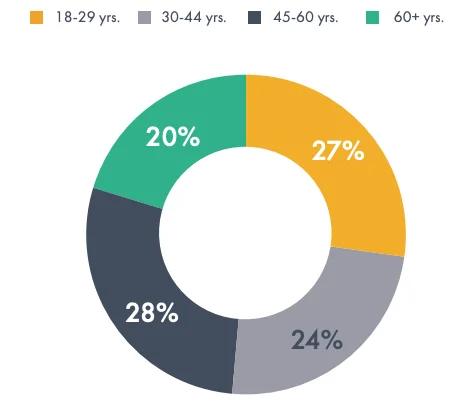
Of all the study participants, about half (46%) of respondents were female; 54% were male. The age breakdown was as follows: 27% were aged 18 to 29, 24% were aged 30-44, 29% were between 45 and 60 years old, while 21% were over 60.
About 20% respondents fell into each of the following annual household income categories: <$25,000, and $25,000 - <$50,000. 19% had the income of $50,000 - <$75,000, while 15% of respondents had income between $75,000 to $100,000. Roughly 22% of respondents’ household incomes were $100,000 and above, while 8% refused to disclose their income.
Fair Use Statement
Online shopping and e-commerce have seen a boost in the last year, not in the least because of the COVID-19 pandemic preventing people from shopping in person in the US and around the world. If you feel that our insights into online shopping patterns and digital discounts can be beneficial to someone, feel free to share this research, but be sure your purposes are noncommercial, and please do provide a citation link back to the research on this page so they have access to our complete findings and survey methods.
Topics Promo codes