Shopping
Why Gen Z and Millennials Prefer Secondhand Shopping — before you pay
Buying secondhand is no longer just about spending less. For Gen Z and millennials, it's become a default way to shop. To understand what's behind this shift in habits, we
Key Takeaways
- Online forum engagement for thrifting is up 46% over the past 3 years.
- 41% of Gen Z and millennial shoppers always or often check resale platforms before buying something new, with 1 in 10 doing so every single time.
- Nearly half of all Gen Z and millennial shoppers (48%) say rising costs drove them to secondhand shopping.
- 47% would still buy secondhand even if they could easily afford to buy new.
- 33% say thrifting is part of their identity, not just a cash-saving habit.
- 61% say they feel more excited finding something secondhand than buying it brand new.
Thrift Culture Online
Online communities have become a major driver of how shoppers discover, share, and celebrate secondhand finds.
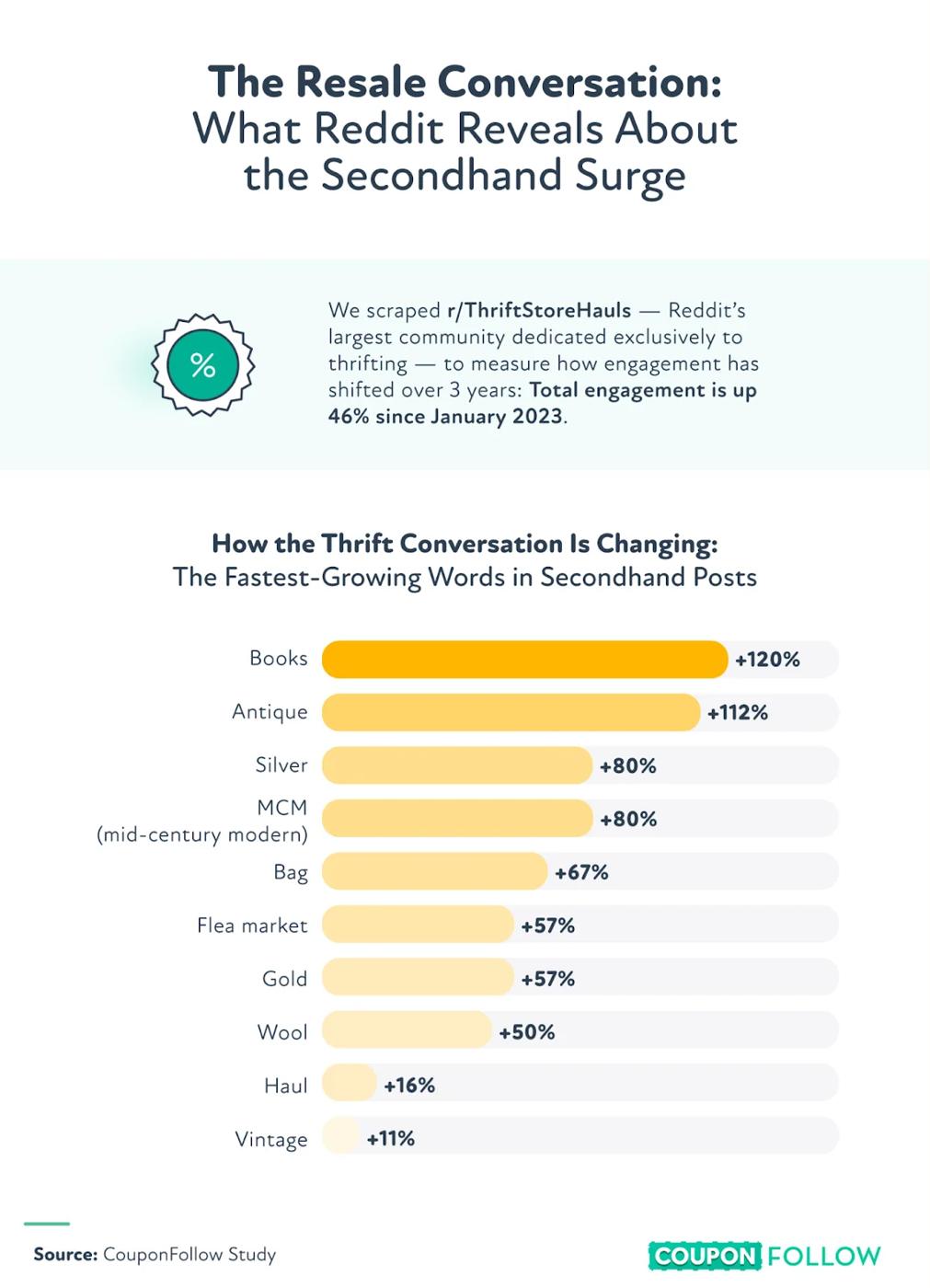
Engagement in online thrifting communities has surged significantly, with activity increasing by 46% over the past 3 years. This growth highlights how secondhand shopping has gone from a quiet, individual habit into a highly social experience. Platforms like Reddit are now hubs where users showcase their best finds, swap tips, and inspire others to shop secondhand.
As engagement rises, so does visibility. More shoppers are being introduced to thrifting through viral posts and high-performing content, helping normalize secondhand shopping across a broader audience. What was once considered a necessary alternative is now firmly embedded in mainstream online culture.
As thrifting becomes more visible online, it's affecting how people shop, often before they ever consider buying new.
Why So Many Shoppers Check Resale Before Buying New
Secondhand shopping used to be something people turned to when money was tight. Now it's where many start their search, regardless of budget.
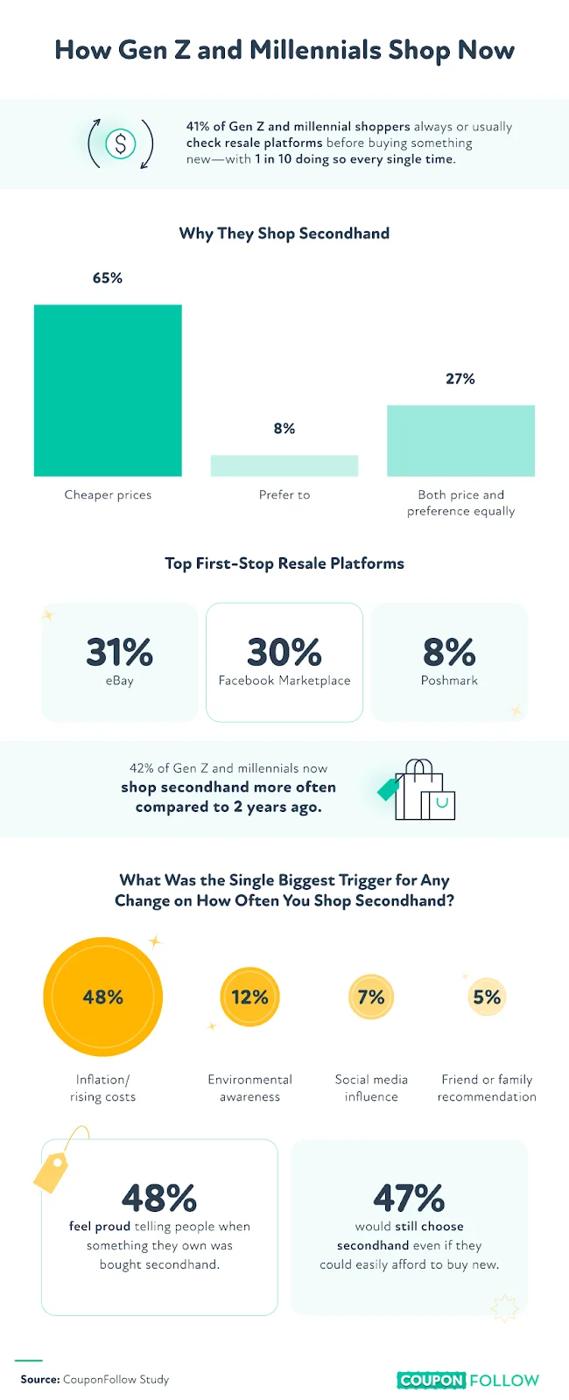
About 2 in 5 Gen Z and millennial shoppers (41%) said they now check resale platforms before buying something new, including 1 in 10 who do it every time. Regarding where people shop, eBay and Facebook Marketplace are running almost neck and neck as the top first stop, at 31% and 30% respectively.
Gen Z was more likely to use Facebook Marketplace (32%) than eBay (24%). But this flipped among millennials, with 33% preferring eBay and 30% favoring Facebook Marketplace. Men's first choice was also eBay (46%), while women preferred Facebook Marketplace (35%).
For close to half of shoppers (48%), thrifting started out of financial necessity, with rising costs pushing them toward secondhand choices in the first place. Others made the shift because of environmental awareness or social influence. One in 10 shoppers said they'd actually feel embarrassed telling someone they bought something brand new.
About 1 in 5 shoppers (18%) actively share their finds online, helping normalize secondhand shopping and influencing others to do the same. Even among those who could easily afford to buy new, nearly half (47%) said they'd still choose secondhand, including 49% of women and 43% of men.
The Emotional Side of Secondhand Shopping
For many shoppers, secondhand isn't just practical. It's deeply personal and even emotional.
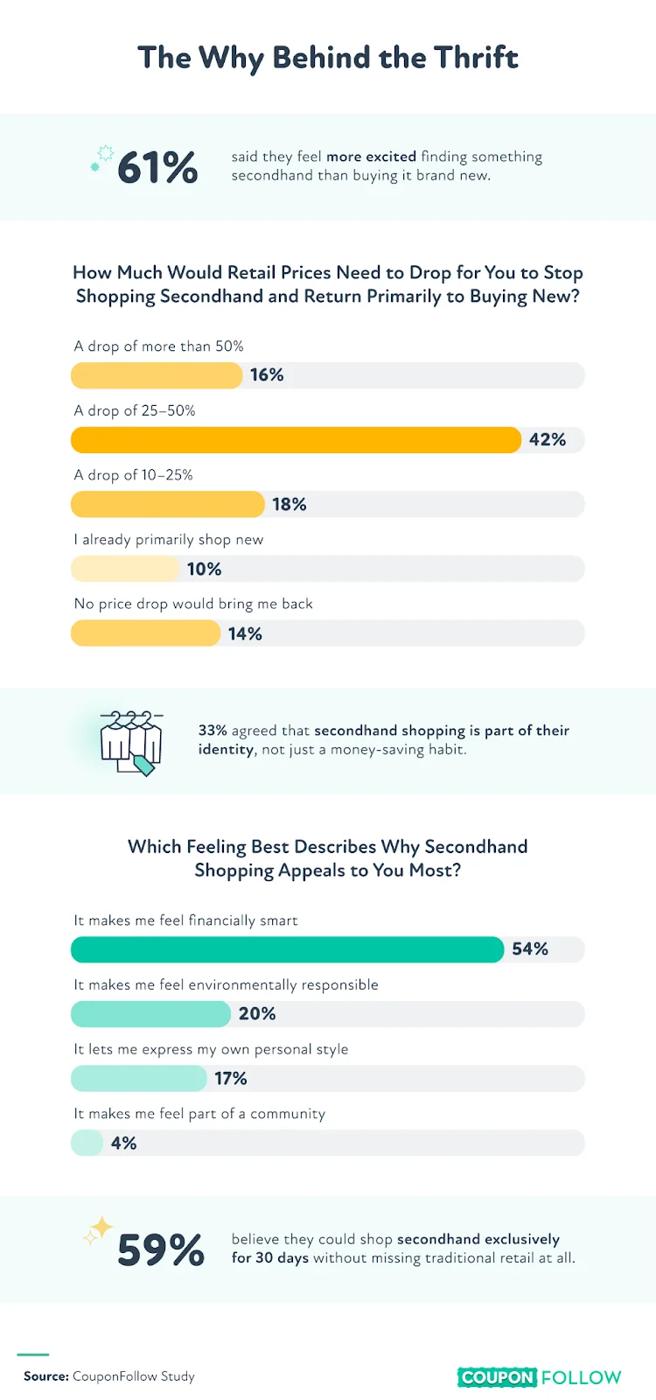
A big part of what keeps people coming back is the thrill of the find. More than 3 in 5 shoppers (61%) said they feel more excited when discovering a secondhand item than when buying something new. That excitement was even stronger among women (67%) compared to men (53%). It's the kind of emotional payoff that goes well beyond saving a few bucks.
Identity also plays a role. A third of shoppers said secondhand shopping is part of who they are, not just a way to spend less. Women felt this more strongly (37%) than men (27%), suggesting that resale is becoming less of a habit and more of a lifestyle choice for many people. And it's not something a simple sale can undo.
Thirty percent of shoppers said even a 50% or greater drop in retail prices wouldn't be enough to bring them back to buying new. That includes 14% who said no sale would convince them. Women were more likely to feel this way (34%) than men (21%).
Shoppers are buying secondhand across a pretty wide range of categories, including:
- Clothing and apparel: 59%
- Books, media, and games: 49%
- Furniture and home decor: 40%
- Electronics: 34%
- Shoes and accessories: 25%
- Sports and outdoor equipment: 20%
- Toys and children's items: 19%
- Jewelry and watches: 14%
Women overwhelmingly gravitate toward secondhand clothing (69%), while men most often pick up books, media, and games (51%), with electronics close behind (47%). Actually, men bought secondhand electronics at nearly double the rate of women (47% vs. 24%).
Resale Is Redefining How We Shop
For Gen Z and millennials, secondhand shopping is often the starting point. Driven by financial pressure, a desire for unique finds, and a broader shift in values, these generations have redefined what it means to shop smart. As resale culture continues to grow, that mindset is here to stay.
Resale-first doesn't have to mean resale-only. The sharpest shoppers treat the secondhand price as a benchmark, not a default, and that comparison matters most in furniture and home decor, where 40% of shoppers now check resale first and where new prices move constantly. A used sofa on Marketplace can look like a steal until you check what the same piece costs new during a sale, which is why it's worth a quick look at current Wayfair discounts before committing to either.
Whether you're a dedicated thrifter or simply looking to make smarter buying decisions, the goal is the same: getting the most value for your money. And if you do buy new, be sure you're not leaving savings on the table by skipping offered coupons and discount codes from platforms like Sacodes.
Methodology
This study draws on two data sources. First, Sacodes surveyed 1,002 U.S. adults ages 18 to 45, representing Gen Z (ages 18–29) and millennial (ages 30–45) shoppers. The survey was conducted in March 2026 and is an exploratory study that's not intended to be nationally representative.
We also analyzed 1,982 top posts from r/ThriftStoreHauls, Reddit's largest thrifting-dedicated community with over 4 million members, comparing activity from January 2023 and January 2026. Posts were ranked by top score within each time window to weight results by engagement. Word frequency was tracked against post titles applying exact word-boundary matching, and engagement was measured as the combined total of upvotes and comments per post.