
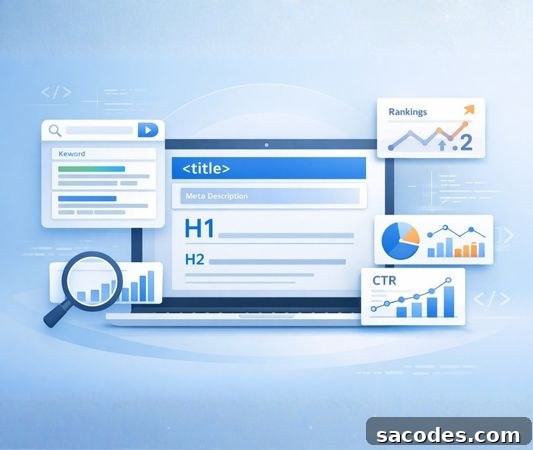
Success in search engine optimization is not limited to producing high-quality content. How content is presented to search engines, how it appears to users, and how algorithms interpret it are at least as important as the content itself. In this context, meta tags and title optimization form essential elements of technical SEO’s backbone.
Meta tags and titles determine a web page’s first impression in search engine results. They directly influence click-through rates, crawlability, and topical relevance. This article examines meta tags, the title tag, meta description, heading hierarchy, and practical optimization techniques from technical, analytical, and implementation perspectives.
What Are Meta Tags in SEO and Why Do They Matter?
Meta tags are elements placed in the HTML document’s
The importance of meta tags in SEO can be grouped into three main areas. First, they clearly communicate a page’s topical focus to search engines. Second, they influence the title and snippet shown in search results, affecting click-through rates. Third, they indirectly contribute to crawl budget, indexing, and page quality assessments.
Although major search engines like Google do not treat meta tags as standalone ranking factors, they assign indirect value through the user behavior signals they influence. Therefore, optimizing meta tags is an integral part of any content strategy aimed at long-term organic performance.
Key Meta Tags Used in SEO
Title Tag
The title tag is the main headline shown in search results and one of the strongest on-page SEO signals. It also appears in browser tabs and directly affects user experience.
Technically, the ideal title length is typically in the 50–60 character range, but more important than raw length are semantic density and keyword placement. Placing the primary keyword as close to the beginning of the title as naturally possible strengthens relevance signals.
Each page should have a unique title tag. Duplicate titles across multiple pages make it difficult for search engines to determine which page should take priority for specific queries.
Meta Description
The meta description is the short summary that appears under the title in search results. While not a direct ranking factor, it has a decisive influence on click-through rate (CTR).
A well-optimized meta description answers the user’s search intent clearly. Keep descriptions within about 150–160 characters, and communicate the page’s value proposition. Natural use of keywords can cause them to be highlighted in search results, increasing visibility.
Be aware of the risk of automatic rewriting: if the description does not closely match page content, search engines may generate their own snippet instead of showing your meta description.
Meta Robots Tag
The meta robots tag tells search engine crawlers how to handle a page, using directives like index, noindex, follow, and nofollow.
This tag is a critical technical SEO tool used for:
- Controlling duplicate content
- Preventing indexing of test or temporary pages
- Managing campaign or filtered URLs
Proper use of the robots directives helps ensure only the intended pages are indexed and prioritized.
Supportive Meta Tags: Viewport and Charset
Although not direct ranking signals, tags like viewport and charset are important for user experience and mobile compatibility. Mobile-friendly pages are prioritized by search engines, so these supportive meta tags contribute indirectly to SEO performance.
Title Optimization and Hierarchical Structure
Title optimization goes beyond the title tag itself. Page headings such as H1, H2, H3, and H4 form the semantic structure of content. Search engines use this structure to understand the main topics and subtopics on a page, which helps with relevance and indexing.
H1 Heading
The H1 tag represents the page’s primary subject and is typically used once. It does not have to be identical to the title tag, but it should be semantically aligned.
A well-structured H1:
- Includes the primary keyword naturally
- Clearly states the page’s purpose
- Encourages the user to continue reading
H2 and H3 Headings
H2 and H3 headings organize subtopics and help both users and search engines follow the logical flow of the content. H2 headings define main subsections, while H3 headings expand those subsections with detail, improving readability—especially in long or technical articles.
Meta Tags and User Intent
Modern SEO focuses less on keyword density and more on user intent (search intent). Meta tags and headings must accurately reflect that intent.
For informational queries, titles and descriptions should be clear and educational. For commercial queries, emphasize value propositions, benefits, and differentiators. When meta tags fail to match intent, impressions may be high but CTR remains low—reducing overall performance.
Common Meta Tag Mistakes
Common mistakes that undermine meta tag effectiveness include:
- Using the same title and meta description across multiple pages
- Keyword stuffing
- Misleading or irrelevant titles
- Meta descriptions that are too long or too short
These errors damage both SEO results and brand credibility.
Technical SEO: Analyzing Titles and Meta Tags
In professional SEO practice, meta tags are not just written and left; they are regularly analyzed. Crawl tools and search console data reveal which titles generate higher CTRs and which are rewritten by search engines.
From these analyses, teams will:
- Re-optimize pages with low CTR
- Test title and description variations
- Measure alignment between user behavior and meta tag messaging
This approach treats SEO as a dynamic process that evolves with user behavior and search engine updates.
A Professional Approach to Meta Tag and Title Optimization
Although meta tag optimization may appear straightforward, it requires technical expertise and strategic planning—especially for large websites where consistent, scalable optimization across hundreds or thousands of pages is necessary. Manual methods are rarely sufficient at scale.
Professional SEO services combine site architecture, keyword mapping, and technical audits to manage meta tags systematically. If you want to improve your site’s meta tags and achieve sustainable SEO performance, structured, expert-driven optimization delivers measurable long-term benefits.