Shopping
Are Subscription Boxes Worth It? Here's Our Analysis of the ROI — before you pay
These days, fewer U.S. shoppers are shopping at brick-and-mortar stores, instead scavenging the web for the best deals and the highest-quality items – an obvious marker of our

These days, savvy shoppers are getting introduced to new foods, makeup, books, perfumes, and even niche collectibles through weekly or monthly subscriptions. The subscription box market is believed to be worth $15 billion, per recent estimates, and experts only expect that number to grow. To learn more about what’s getting U.S. shoppers to open their wallets, we surveyed 1,007 consumers in the United States who receive at least one subscription box a month. To learn more about people’s buying habits, spending power on these items, and perceived value of these subscriptions – and what it could mean in context of our ever-changing economy – keep reading.
Dopamine Delivery
Subscription boxes are no doubt convenient and fun, but some research suggests that there’s also a chemical payoff for buying into them. Opening these boxes are thought to release dopamine, a pleasure molecule, in a way that’s similar to the satisfaction that someone gets when they receive plenty of text messages or when they gamble.
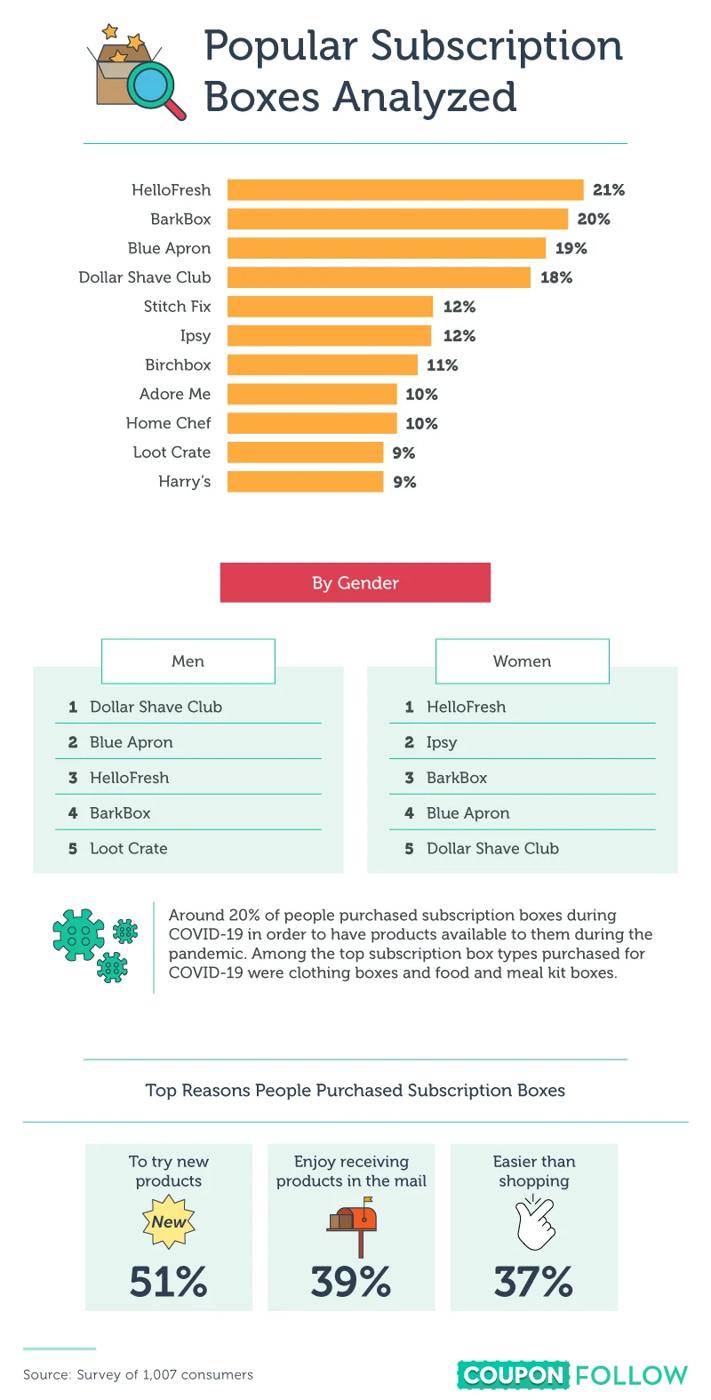
We asked shoppers why they purchased subscription boxes and where they’re spending those precious dollars. Our data suggests that more than half of those surveyed (51%) bought subscription boxes to try new items, while another 39% said they simply enjoy receiving items in the mail. About 37% of our sample found subscription boxes “easier than shopping.”
The most popular subscription boxes were HelloFresh (21%) for meals, BarkBox for dog toys and treats (20%), and Blue Apron (19%), another meal kit delivery service. The Dollar Shave Club was most popular among men, while women subscribed to HelloFresh the most and Ipsy – a makeup and “glam box” delivery service – second most. Meanwhile, in the era of COVID-19, around 20% of people purchased subscription boxes just to have those items offered to them during the pandemic, with clothing boxes and meal kit boxes ranking highly.
Incentives for Consumers
Subscription box services tend to offer a signup incentive to get shoppers hooked. At Sacodes we’ve seen many of the subscription box businesses offer discounts to new shoppers signing up for their service for the first time. Discounting strategies ranged from free months, to dollar or percent discounts, and even doubling boxes. For instance, we’ve seen a Blue Apron coupon good for $20 off each of the first 3 boxes for new shoppers. Other discount strategies we’ve seen were a Barkbox discount to double your first box for free with a multi-month subscription along with 35% off themed monthly boxes.
Overall, these types of incentive strategies mirror what meal and food delivery businesses are doing as well. These businesses include DoorDash, Uber Eats, Grubhub and others. They are actively trying to gain market share by offering new or loyal shoppers extra discounts on their meal orders. Sacodes tracks promotions for a mix of food delivery businesses and (for just one example) we’ve seen DoorDash discount codes fetch new users $5 off their meal order, or in some instances up to 40% off.
Editor’s Note: For further research and analysis on costs of ordering meals and food, along with incentives, check out our latest post on Meal Delivery trends.
Future Competition in the Subscription Box Industry
It’s possible we will see increased competition in the future from larger brands launching their own subscription services. As an example (and purely speculation), Barkbox may eventually face competition from mainstream larger pet food businesses, like Chewy.com. While Chewy hasn't directly jumped into subscription boxes per se, it does have a couple different spins on this type of model. They offer an Autoship choice which is heavily incentivized - which it taglines "What Your Pet Needs. On Repeat". So while a rotating variety isn’t there, the automatic shipment mechanism is in place. As an incentive, Chewy shoppers can get 35% off Autoship eligible items, plus up to $20 off on their first Autship offer - additionally a mix of first-time shopper Chewy discount codes exist which seem to rotate periodically but can fetch up to 40% off.
Chewy also offers the “Chewy Goody Box” which combines themed, and specially curated, pet gift boxes with savings. One could imagine they could potentially combine some of these elements into a competitive subscription box model if they thought it would have a positive ROI on their business.
Perceived Value of the Box
Subscription boxes can often be perceived as “luxurious” or “splurging” because businesses are carefully curating what arrives at consumers’ doors every month. But are U.S. shoppers viewing their subscription boxes that way – and how much are they spending on them each month?
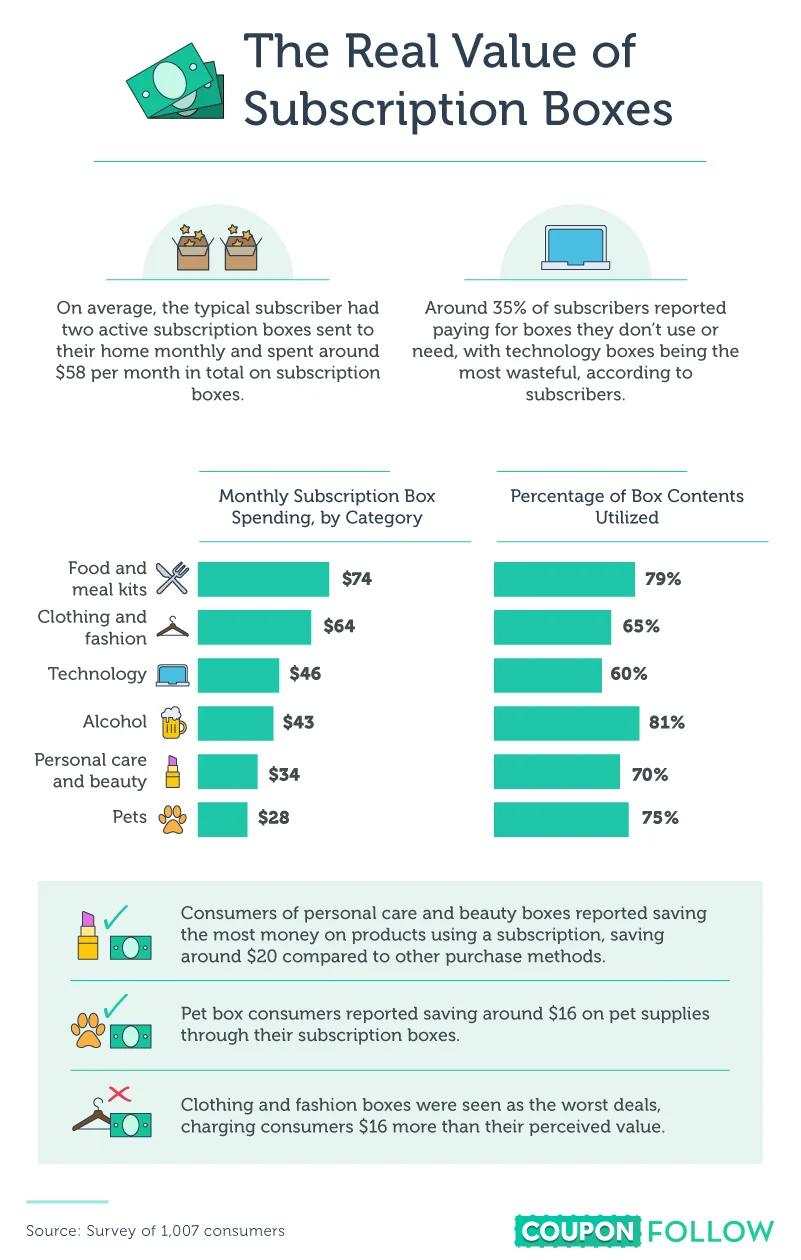
Our survey reveals that, on average, consumers had two active subscription boxes, spending a monthly total of around $58. Interestingly, more than a third of respondents said that they’re paying for boxes they don’t really use or need. These consumers indicated that certain types of subscriptions have a perceived sense of waste, but continued to purchase these boxes to try out new items.
People spent the most on food and meal kits, averaging at about $74 a month, but these types of subscriptions were also among the most likely to be used (79% of subscribers reported applying these kits). Alcohol subscription boxes – which averaged $43 in spending a month – were also very likely to be used (81%). Meanwhile, those that had clothing or fashion subscriptions spent an average of $64 a month, but only 65% of consumers said they actually used them. The most wasteful of all subscriptions, however, were those related to technology. For these boxes, people spent an average of $46 a month, but only 60% of subscribers said they wound up applying these items.
Here’s a cash-saving tip for conscious shoppers: Our data suggest that consumers of personal care and beauty boxes reported saving the most money on their items, at around $20 per month compared to other buying methods. Pet box consumers also reported high savings by subscribing to boxes, while clothing and fashion boxes were the worst perceived deals.
Demographic Deals
Broadly, those interested in consumer trends tend to analyze shoppers by their demographics to understand them. For that reason, we asked more than 1,000 shoppers of different ages and genders about their spending habits on subscription boxes.
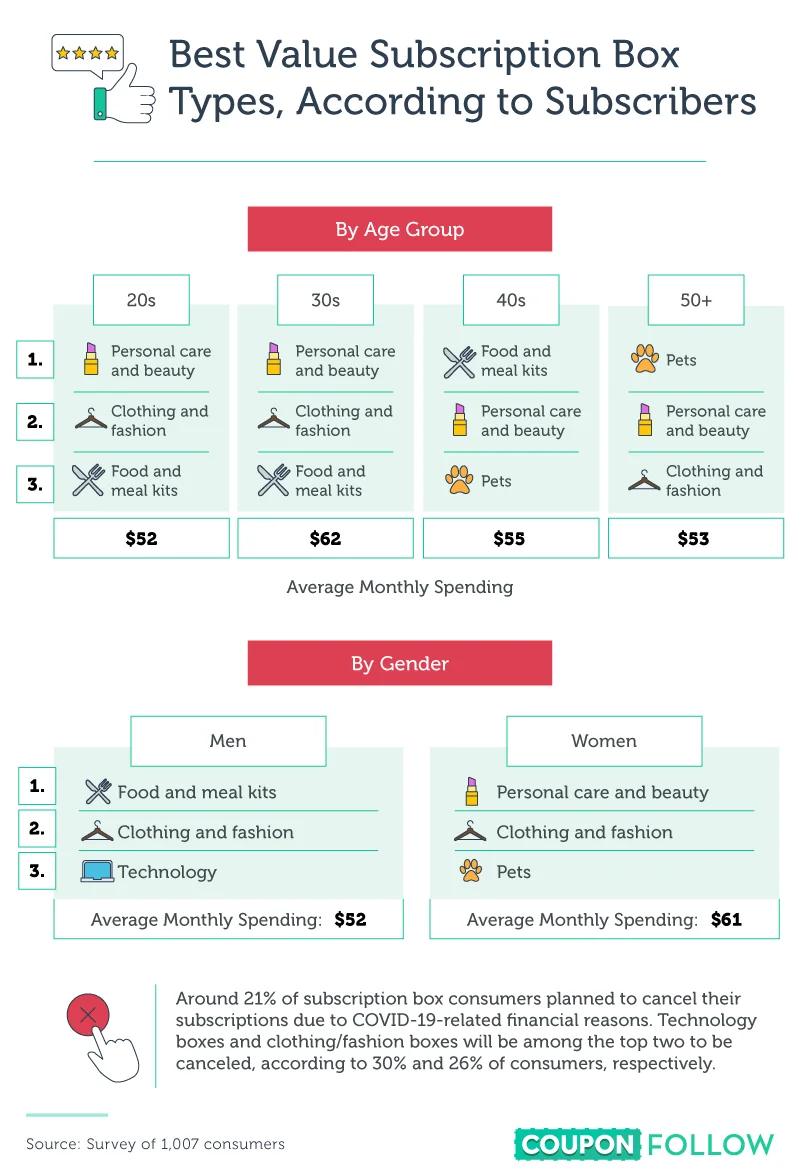
We discovered people in their 20s and 30s were most interested in personal care and beauty boxes, along with clothing and fashion boxes or food and meal kit boxes. For people in their 40s and beyond, subscription boxes for pets were notably popular, and those in the oldest age bracket – 50s and older – were least likely to be interested in food or meal kit boxes.
However, all age groups generally tended to spend the same amount on subscription boxes per month, though people in their 30s had the highest spending, at $62. Men on average spent more than women on subscription boxes – a $9 difference – while the types of subscription boxes varied between the genders. Women reported spending on personal care and beauty boxes the most, along with clothing and fashion boxes and pet supply boxes. Men, then again, generally paid for food or meal kit boxes the most, followed by clothing and fashion and technology boxes.
This details could no doubt help businesses better tailor to their target consumers, especially in the era of the novel coronavirus, when budgets are getting increasingly tight for millions of people. Around 21% of subscription box consumers surveyed said they plan to cancel their boxes because of financial struggles caused by COVID-19, and technology boxes or clothing and fashion boxes appeared the most likely to go.
Subscriptions and the Future
With millions of U.S. shoppers filing for unemployment in face of COVID-19, it’s unclear what the future of the subscription box market may look like. However, tight wallets mean that consumers might be looking for good deals, and our survey of more than 1,000 shoppers in the U.S. suggests that some are indeed keeping more cash by subscribing to these services.
As more U.S. shoppers look to couponing and deals to stretch their money further, Sacodes offers real-time, up-to-date coupons from a ton of brands, including subscription boxes for popular meal kits. To spend less on your favorite subscription box or to hunt for the best deals, browse Sacodes.com and for the best deals and discounts from all of your favorite brands.
Methodology and Limitations
We surveyed 1,007 American consumers who are subscribed to at least one subscription box to explore subscription box buying habits, perceived value, and the cost of these items. Around 51% of our respondents were men, and 49% were women, and ages of our respondents ranged from 18 to 78 with a mean age of 35 and standard deviation of 11 years. Survey data include certain limitations because of self-reporting, including exaggeration, selective memory and telescoping. Data were not weighted, and no statistical testing was provided to support the hypothesis. This was an exploratory study on the usefulness and enjoyment of subscription boxes across assorted categories.
Fair Use Statement
Want to help your friends find the perfect subscription box? Feel free to share our story for noncommercial purposes only, but link back to our study to give us some credit!
Topics Delivery


![Coupon Usage & Shopping Behavior Trends [REPORT] (2021)](/assets/media/coupon-usage-trends-6f52a19d.jpg)